Chapter 1
Chapter 1
An Overview of the Public Service Commission
1.1
The Public Service Commission is an
independent statutory body which
advises the Chief Executive (CE) on
civil service appointments, promotions
and discipline. Its mission is to safeguard
the impartiality and integrity of the
appointment and promotion systems in
the Civil Service and to ensure that a high
standard of discipline is maintained. The
Commission’s remit is stipulated in the
Public Service Commission Ordinance
(PSCO) and its subsidiary regulations
(Chapter 93 of the Laws of Hong Kong).
Membership
1.2
In accordance with the PSCO, the
Commission comprises a Chairman and
not less than two but not more than eight
Members. All of them are appointed by
the CE and have a record of public or
community service. The membership
of the Commission during 2025 was as
follows –
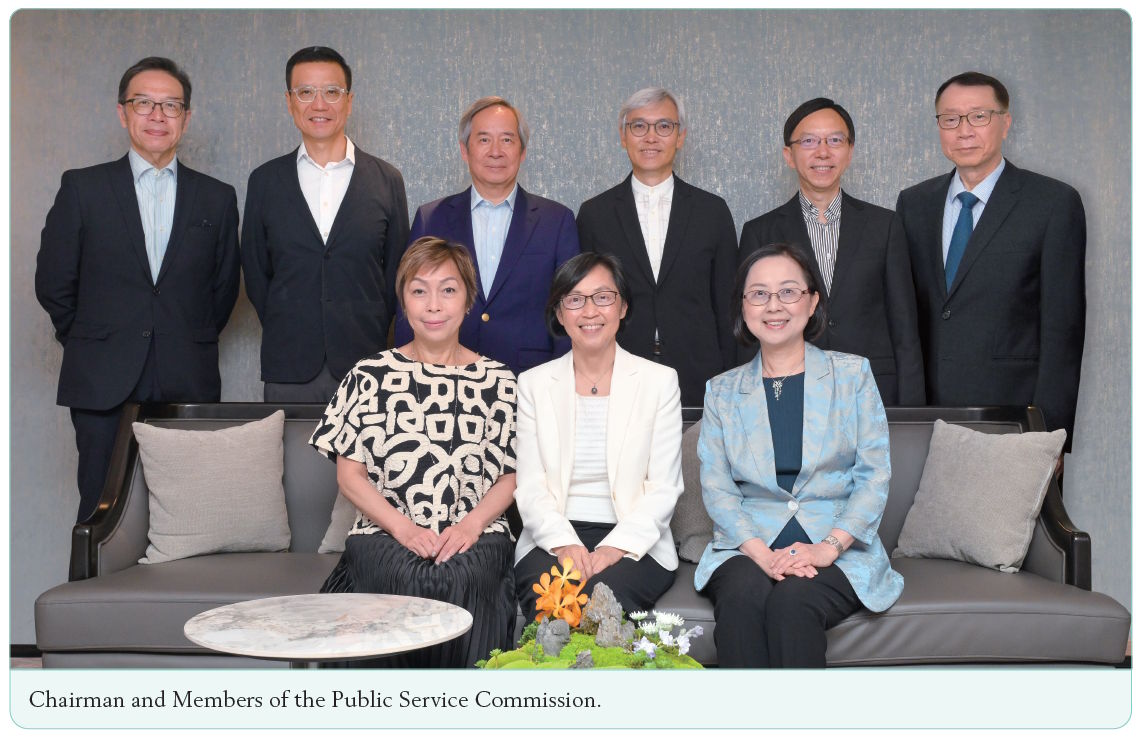
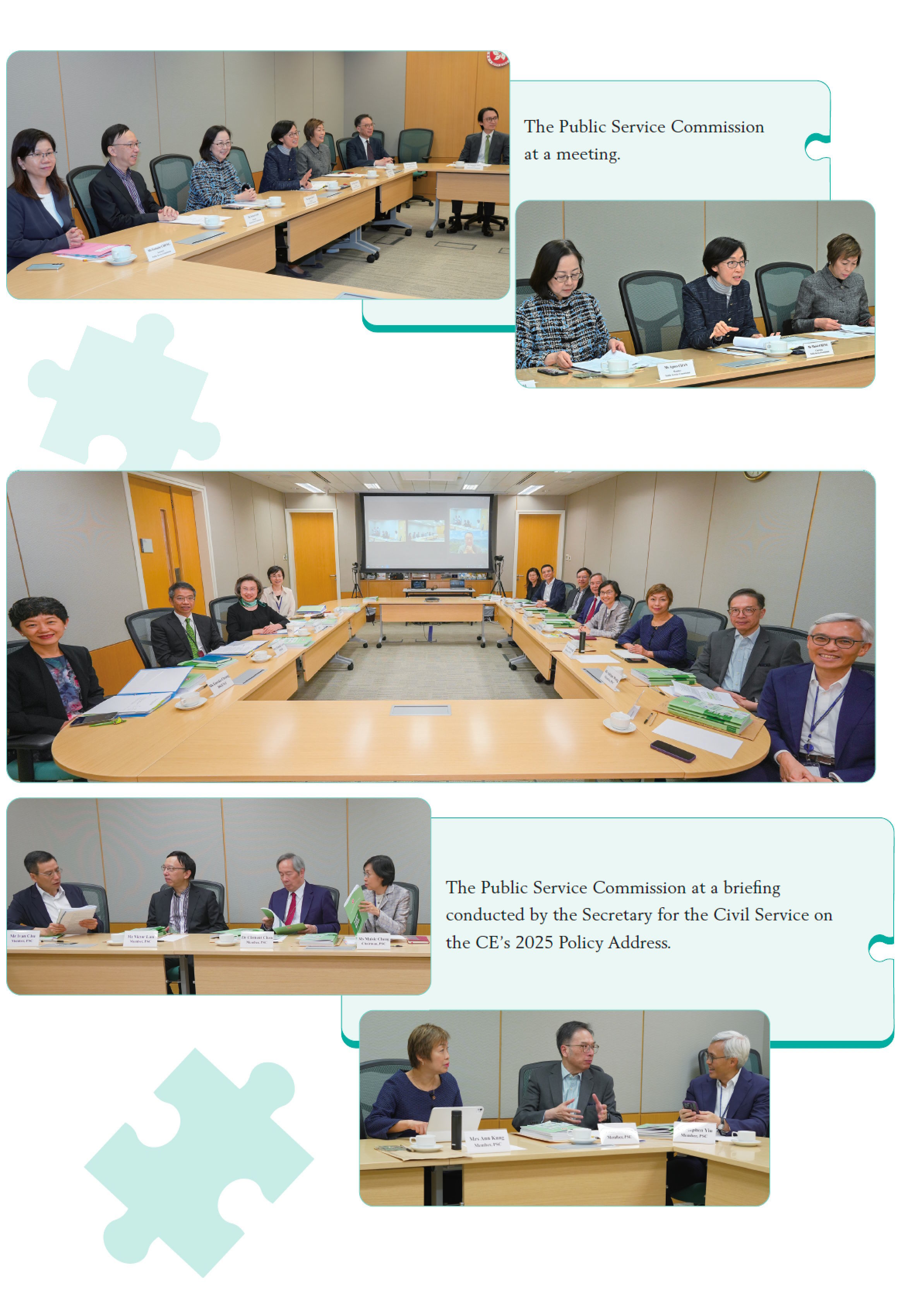
Curricula vitae of the Chairman and Members are at Appendix I.
Chairman
Ms Maisie CHENG Mei-sze, GBS, JP
since May 2023
Members
Dr Clement CHEN Cheng-jen, GBS, JP
December 2019 to November 2025
Prof Francis LUI Ting-ming, BBS, JP
since June 2021
Ms Agnes CHAN Sui-kuen, BBS
since May 2022
Mrs Ann KUNG YEUNG Yun-chi, BBS, JP
since May 2022
Mr Victor LAM Wai-kiu, SBS
since February 2024
Mr Adrian WONG Koon-man, BBS, MH, JP
since February 2024
Mr Ivan CHU Kwok-leung
since July 2024
Mr Stephen YIU Kin-wah, JP
since July 2024
Mr Samuel CHAN Ka-yan, BBS, JP
since December 2025
Secretary
Ms Fontaine CHENG Fung-ying, JP
since October 2018
Curricula vitae of the Chairman and Members are at Appendix I.
Secretariat
1.3
The Commission is supported by a small
team of civil servants from the Executive
Officer, Secretarial and Clerical grades.
At the end of 2025, the number of
established posts in the Commission
Secretariat was 34. An organisation
chart of the Commission Secretariat is at
Appendix II.
1.4
The Commission’s role is advisory.
With a few exceptions specified in
section (s.) 6(2) of the PSCO1, the
Commission advises on the appointments
and promotions of civil servants to
posts with a maximum monthly salary
at Master Pay Scale Point 26 ($59,110
as at end of 2025) or above, up to and
including Permanent Secretaries and
Heads of Department (HoDs). The
appointment of the Principal Officials
of the executive authorities of the Hong
Kong Special Administrative Region
(HKSAR) as stipulated under the Basic
Law of the HKSAR of the People’s
Republic of China does not fall under the
purview of the Commission. At the end
of June 2025, the number of established
civil service posts falling under the
Commission’s purview was about 55 000
out of a total of about 190 000. However,
irrespective of rank, the following
categories of cases are required to be
referred to the Commission for advice.
They are –
(a)
cases involving termination (including
non-renewal) of agreement and
further appointment on agreement
terms or new permanent terms under
the circumstances as specified in
Civil Service Bureau (CSB) Circular
No. 8/2003 and the relevant
supplementary guidelines issued by CSB;
(b)
termination or extension of probationary
or trial service, except for certain
extension cases which involve sick
leave and light duty as prescribed and
promulgated by CSB in November 2023;
(c)
refusal of passage of probation or trial bar;
and
(d)
retirement in the public interest
under s.12 of the Public Service
(Administration) Order (PS(A)O)2.
1
In accordance with s.6(2) of the PSCO, the post of the Director of Audit as well as posts in the judicial service of the Judiciary,
the Independent Commission Against Corruption and the disciplined ranks of the Hong Kong Police Force are outside the
Commission’s purview. In addition, the Director of Immigration and the Commissioner of Customs and Excise are civil
servant Principal Official posts, to which the appointment does not require the Commission’s advice.
2
The PS(A)O is an executive order made by the CE under Article 48(4) of the Basic Law. It sets out the CE’s authority in
regard to the management of the Civil Service, including discipline matters.
1.5
As regards disciplinary cases, the
Administration is required under s.18 of
the PS(A)O3 to consult the Commission
before inflicting any punishment
under s.9, s.10 or s.11 of the PS(A)O
upon Category A officers with the
exception of the exclusions specified
in the PSCO. Category A officers refer
to those who are appointed to and
confirmed in an established office or are
members of the Civil Service Provident
Fund (CSPF) Scheme4. They include
virtually all officers except those on
probation, agreement and some who
are remunerated on the Model Scale 1
Pay Scale. At the end of June 2025, the
number of Category A officers falling
under the Commission’s purview for
disciplinary matters was about 125 000.
3
Generally speaking, with the exception of middle-ranking officers or below in disciplined services grades who are subject
to the respective disciplined services legislation, civil servants are governed by disciplinary provisions in the PS(A)O. For
disciplinary cases processed under the respective disciplined services legislation of which the punishment authority is the CE
(or his delegate), the Government will, subject to the exclusions specified in s.6(2) of the PSCO, consult the Commission
on the disciplinary punishment under s.6(1)(d) of the PSCO.
4
The CSPF Scheme is the retirement benefits system for civil servants appointed on or after 1 June 2000 and on New
Permanent Terms of appointment.
1.6
The Commission also handles
representations from officers on matters
falling within its statutory purview
and in which the officers have a direct
and definable interest. In addition, the
Commission is required to advise on
any matter relating to the Civil Service
that may be referred to it by the CE.
The Commission also advises the
Secretary for the Civil Service on policy
and procedural issues pertaining to
appointments, promotions and discipline
as well as on a wide range of subjects
relating to human resource management.
1.7
The business of the Commission is
normally conducted through circulation
of papers. Meetings are held to discuss
major policy issues or cases which
are complex or involve important
points of principle. At such meetings,
representatives of CSB and senior
managements of Bureaux/Departments
(B/Ds) may be invited to apprise the
Commission of the background of the
issue or case but the Commission forms
its views independently.
1.8
In examining submissions from B/Ds,
the Commission’s primary aim is to
ensure that the recommendations
are well justified and are arrived at
following the laid down procedures and
stipulated guidelines. To achieve this, the
Commission has devised a meticulous
vetting system and, in the process, may
require B/Ds to provide clarifications
and supplementary information. In
some cases, B/Ds would revise their
recommendations after taking into
account the Commission’s observations.
In other cases, the Commission is able
to be satisfied with the propriety of the
recommendations after examining the
elaborations provided. The Commission
also tenders suggestions or reminders to
B/Ds on areas worthy of management
attention. The ultimate objective is to
facilitate the pursuit of excellence in
the administration of the appointment,
promotion and disciplinary systems in the
Civil Service.
1.9
In accordance with s.12(1) of the
PSCO, the Chairman or any member
of the Commission or any other person
is prohibited from publishing or
disclosing to any unauthorised person
any information which has come to
his knowledge in respect of any matter
referred to the Commission under
the Ordinance. Under s.13 of the
PSCO, every person is prohibited from
influencing or attempting to influence
any decision of the Commission or
the Chairman or any member of the
Commission. These provisions serve to
provide a clear and firm legal basis for
safeguarding the confidentiality and
impartial conduct of the Commission’s
business.

1.10
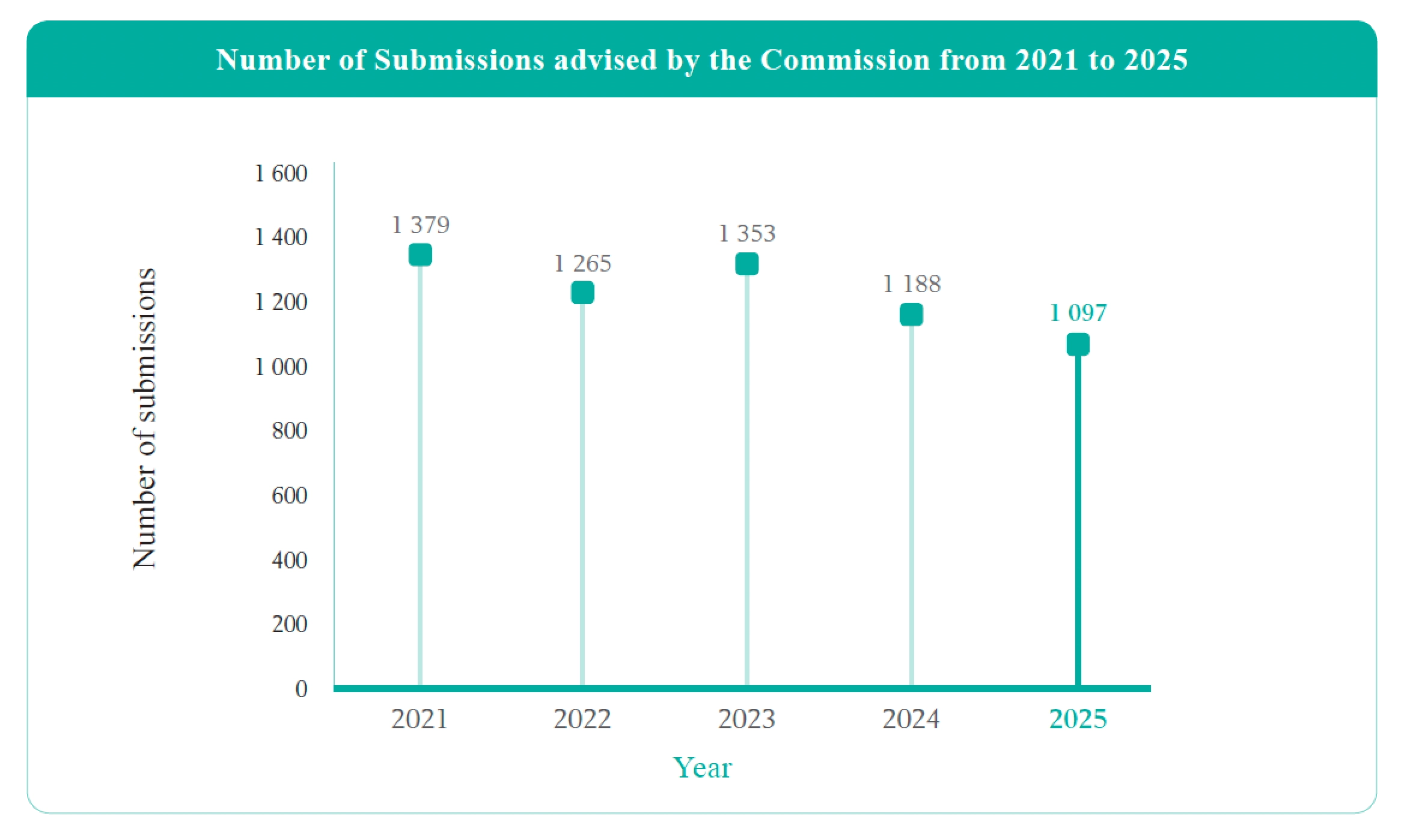
In 2025, the Commission advised on
1 097 submissions covering recruitment,
promotions and disciplinary cases as
well as other appointment-related
subjects. Queries were raised in
respect of 722 submissions, resulting
in 98 re-submissions (14%) with
recommendations revised by B/Ds in the
light of the Commission’s comments.
All submissions in 2025 were completed
within the pledged processing time5. A
statistical breakdown of these cases and
a comparison with those in the past four
years are provided in Appendix III.
5
In dealing with promotions and disciplinary cases, the Commission’s target is to tender its advice or respond formally within
six weeks upon receipt of the submissions. As for recruitment cases, the Commission’s target is to tender advice or respond
within four weeks upon receipt of such submissions.
1.11
Furthermore, the Commission Chairman
continued to attend board meetings
convened by various B/Ds (hereafter
referred to as “selection meetings”),
covering appointments, promotions,
and further employment matters, in the
capacity of an observer. During these
meetings, the Commission Chairman
offered strategic insights and suggested
enhancement measures to address
observed inadequacies as necessary, while
also providing guidance on compliance
with established rules and procedures. This
year, the Commission Chairman attended
over 60 selection meetings, with several
Commission Members also participating as
observers in some of these meetings.
1.12
Separately, the Commission handled
a total of 42 representations and
complaints in 2025. We deal with
representations and complaints seriously
as follows –
(a)
all representations under the
Commission’s purview are replied to
following thorough examination. Should
inadequacies or irregularities in B/Ds’
work be identified in the process, the
Commission will provide advice to B/Ds
concerned for rectification; and
(b)
for complaints, which vary in nature,
the Commission will deliberate on
the substance of the complaints upon
obtaining the facts and information from
the relevant B/Ds, and give replies after
careful examination. Where the matters
raised fall outside the Commission’s
purview, we will re-direct them to the
relevant B/Ds for follow-up and reply.
1.13
The Commission has a key role to ensure
compliance and consistency in the
application of policies and procedures
pertaining to appointments, promotions
and discipline in the Civil Service.
While staff training and development
are the fundamental responsibilities
of departmental and grade
managements (GMs), the Commission
has been working with CSB to promote
a holistic approach in developing a
comprehensive Human Resource
Management strategy which best serves
the interest of the Civil Service.
1.14
Specifically, robust staff management
is essential for sustaining high standards
of performance and conduct in the Civil
Service. In some disciplinary cases,
if supervisors properly and diligently
fulfill their supervisory and monitoring
responsibilities, some acts of misconduct
by their subordinates could be detected
at an early stage or even totally avoided.
This is particularly important for those
supervisors at the middle level to do so
as many of them are usually responsible
for supervising sizable teams of junior/frontline staff. It is imperative for them
to equip themselves with the necessary
skills to manage staff with performance
and/or conduct issues. The Commission
is pleased that CSB, taking heed of the
Commission’s advice, launched an online
training programme for these supervisors
in December 2025 with a view to
strengthening their staff management
skills. More details about this training
initiative are set out in Chapter 5.
1.15
In 2025, the Commission continued
to field officers from the Commission
Secretariat to participate by offering
observations and views in training
sessions and workshops organised
for officers of the Executive Officer
Grade and GMs. Equipping them
with the necessary knowledge
and expertise in human resource
management is imperative in ensuring
that the recruitment, management
of probationers, promotion and
performance management systems
are administered properly and in full
compliance with civil service policies
and rules. These interactive training
sessions and workshops fostered active
engagement, where officers could
exchange experiences and deepen
their understanding of human resource
management practices. We were
delighted with the positive feedback
gauged. Moreover, these forums have
strengthened communication between
the Commission and B/Ds, allowing
subject officers to become better
acquainted with the Commission’s
standard and requirements, thereby
enhancing our mutual efficiency.
1.16
Last year, the Commission advised
B/Ds, where necessary, to arrange for
supervising officers to attend the relevant
appraisal management courses organised
by the Civil Service College. The
Commission is pleased to note that B/Ds
have responded positively, addressing
actively the identified inadequacies in
performance management by providing
necessary training to their supervisory
officers. The Commission will continue
to work closely with CSB in this regard.
1.17
Separately, through our scrutiny of
various submissions, the Commission
has observed that certain B/Ds may face
different challenges in handling matters
related to appointments, performance
management and staff development.
To foster mutual understanding, the
Commission will normally schedule
targeted visits to two B/Ds in a year.
During these visits, the Commission
will have exchanges with these B/Ds
and may suggest enhancement measures
and, if necessary, ask the B/Ds to
report back to the Commission on the
progress of the measures taken and the
improvements made. The visits arranged
for the Commission in 2025 are set out
in Chapter 6. The Commission will
continue to visit B/Ds to discuss areas and
matters of mutual interest.
1.18
The Commission’s homepage can be
accessed at the following address –
The homepage provides information on
the Commission’s role and functions,
its current membership, the way the
Commission conducts its business and
the organisation of the Commission
Secretariat. Our Annual Reports (from
2001 onwards) can also be viewed on the
homepage and can be downloaded.
1.19
An Index of the advice and observations
of the Commission on civil service
recruitment, appointment, discipline
and other human resource management
issues cited in the Commission’s
Annual Reports since 2001 is provided
on the homepage. The objective is to
provide human resource management
practitioners in B/Ds and general readers
with a ready guide for quick searches of
the required information.