Chapter 2
Chapter 2
Civil Service Appointments
2.1
Civil servants, who are the backbone
of the HKSAR Government, are
duty-bound to observe and implement
the principle of “One Country, Two
Systems”, safeguard national security as
well as uphold the Basic Law and the
rule of law. Maintaining a workforce
of civil servants, who are loyal to the
Government, dedicated to their duties,
committed to serving the community and
at the same time objective and impartial
in the discharge of duties, is of vital
importance to the effective governance
of the Government. In view of the
foregoing, civil service appointment has
to be highly selective to ensure that only
the most suitable and meritorious are
recruited and appointed into the Civil
Service.
2.2
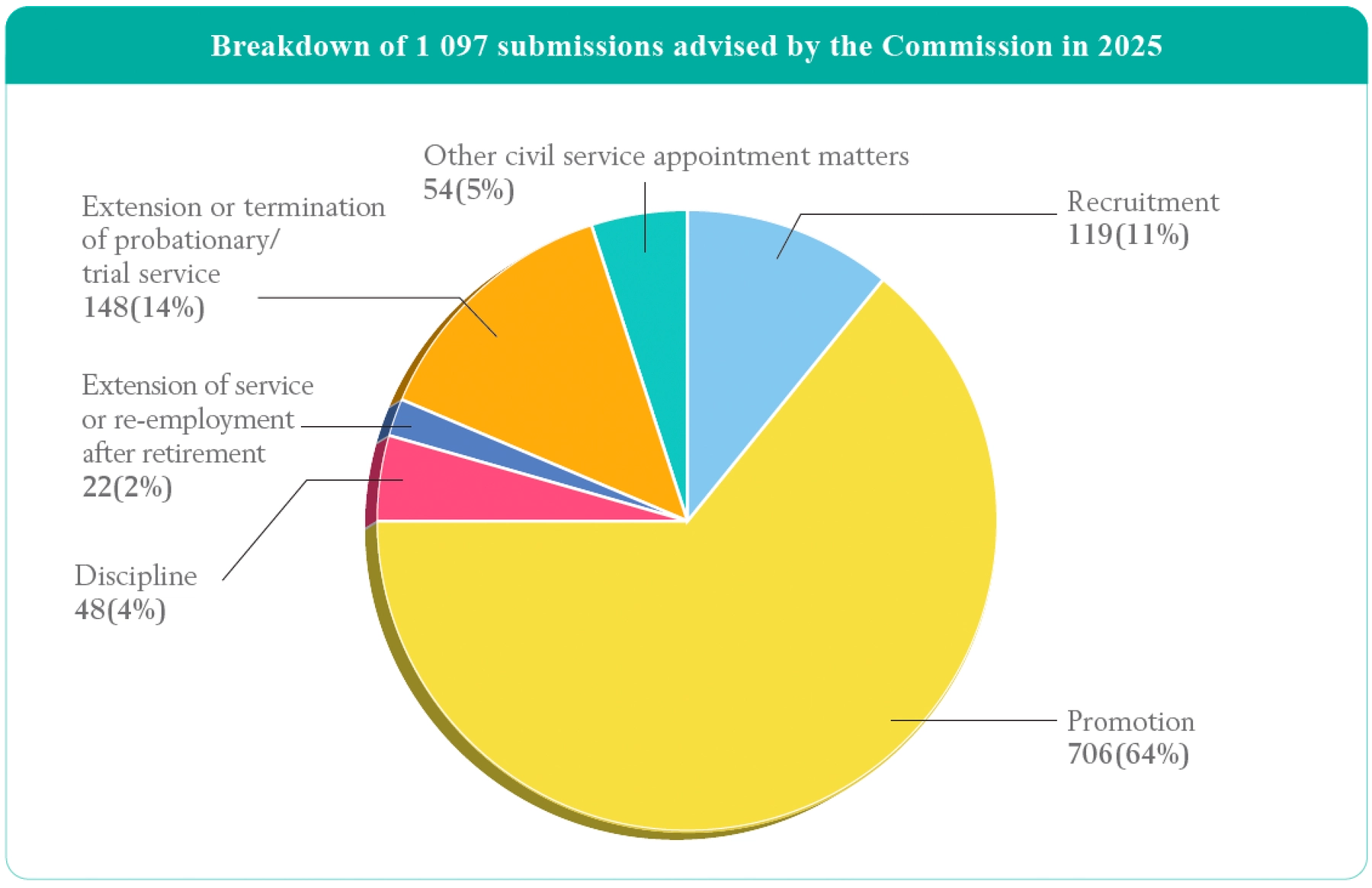
In 2025, the Commission considered and
tendered advice on 1 097 case-specific
submissions with breakdown below –
2.3
Apart from tendering advice and
observations on case-specific
submissions, the Commission also works
closely with CSB to provide views on
new appointment policies, improve and
streamline appointment procedures
as well as propose subjects for review,
where appropriate, for a better and more
efficient appointment system. An overall
account of the Commission’s work is
detailed in this Chapter.
2.4
Recruitment to the Civil Service is
undertaken by CSB and individual B/Ds
which may take the form of an open
recruitment or in-service appointment or
both. Where submissions are required to
be made to the Commission6, we need
to be satisfied that objective selection
standards and proper procedures are
adopted in the process. B/Ds are required
to consult the Commission in advance on
the introduction of any new shortlisting
criteria in a recruitment exercise to
ensure that they are appropriate and
fair. We also advise B/Ds on measures to
enhance the efficiency and effectiveness
of the recruitment process so that offers
can be made to successful candidates as
early as possible.
6
They refer, for the purpose of recruitment, to ranks attracting a maximum monthly salary not less than the amount specified
at Master Pay Scale Point 26 ($59,110 as at end-2025) or equivalent, but exclude (a) the basic ranks of non-degree entry
and non-professional grades; and (b) judicial service, the Independent Commission Against Corruption and the disciplined
ranks of the Hong Kong Police Force which are specifically outside the purview of the Commission.
2.5
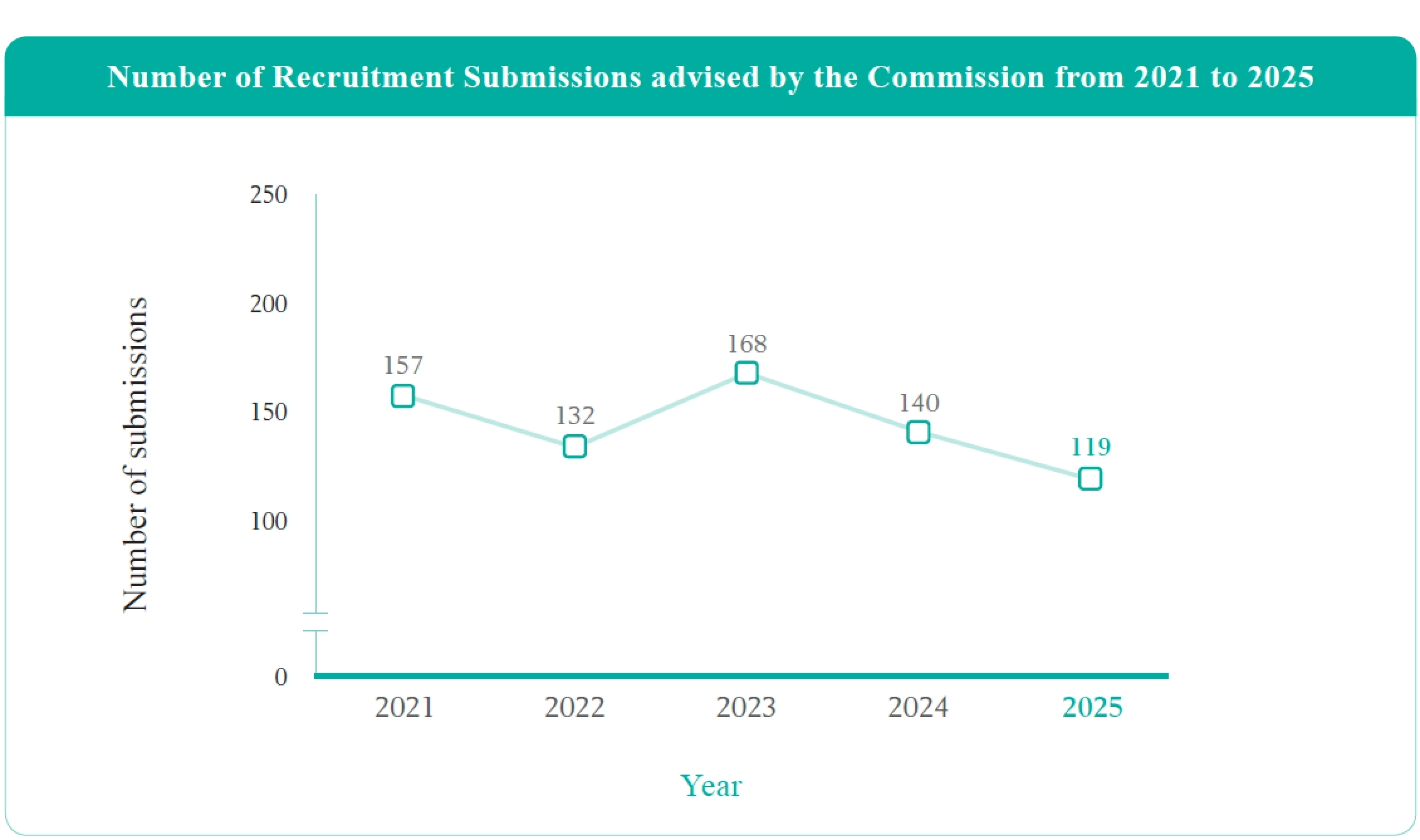
In 2025, the Commission advised on
119 recruitment submissions involving
the filling of 1 254 posts, of which 1 218
posts (in 114 submissions) were
through open recruitment and 36 posts
(in five submissions) by in-service
appointment. A statistical breakdown
of these appointments is provided
at Appendix IV. The number of
recruitment submissions advised by the
Commission in the past five years is
shown below –
More observations made by the Commission in the year relating to recruitment are provided in Chapter 3.
Management of Officers on Probation/Trial
2.6
Requiring an appointee to undergo a
probationary/trial period serves manifold
purposes, including –
(a)
providing an opportunity for the officer
to demonstrate his suitability for further
appointment in the Civil Service;
(b)
allowing the appointment authority to
assess the performance and conduct of
the appointee and be satisfied that he/she
is fit for continuous employment; and
(c)
giving the appointee time to acquire
the necessary qualifications or pass the
prescribed tests for further appointment
in respect of specific civil service jobs.
To uphold the proper administration
of the probation/trial system, HoDs/Heads of Grade (HoGs) have the
overall responsibility of overseeing the
management of officers on probation/trial.
2.7
To maintain a high quality Civil Service,
it is vital for HoDs/HoGs to adopt
stringent suitability standards in assessing
the performance and conduct of officers
on probation/trial to ensure that only
those who are suitable in all respects are
allowed to pass the probation/trial bar
for continued appointment. According
to the guidelines promulgated by CSB
and as provided for under Civil Service
Regulations (CSRs), termination of an
officer’s probationary/trial service is not
a punishment. If at any time during the
probationary/trial period, an officer on
probation/trial is found to have failed
to measure up to the required standards
of performance/conduct and displayed
little progress despite having been given
guidance and advice by their supervising
officers and/or GMs, the HoD/HoG
concerned should take early and resolute
action to terminate his service under
CSR 186/200 without the need to
wait until the end of the probationary/trial period or recourse to disciplinary
proceedings.
2.8
While fair opportunities should be given
to new appointees to pursue a long-term
career in the Government, extension of
probationary/trial period should not be
used as a substitute for termination of
service or solely for the purpose of giving
an appointee more time to prove his
suitability. It is only in very exceptional
circumstances where the officer, though
not yet fully meeting the suitability
standards, has shown positive and strong
indication to be able to achieve the
standards within the extension period
that an extension of his probationary/trial
period should be granted.
2.9
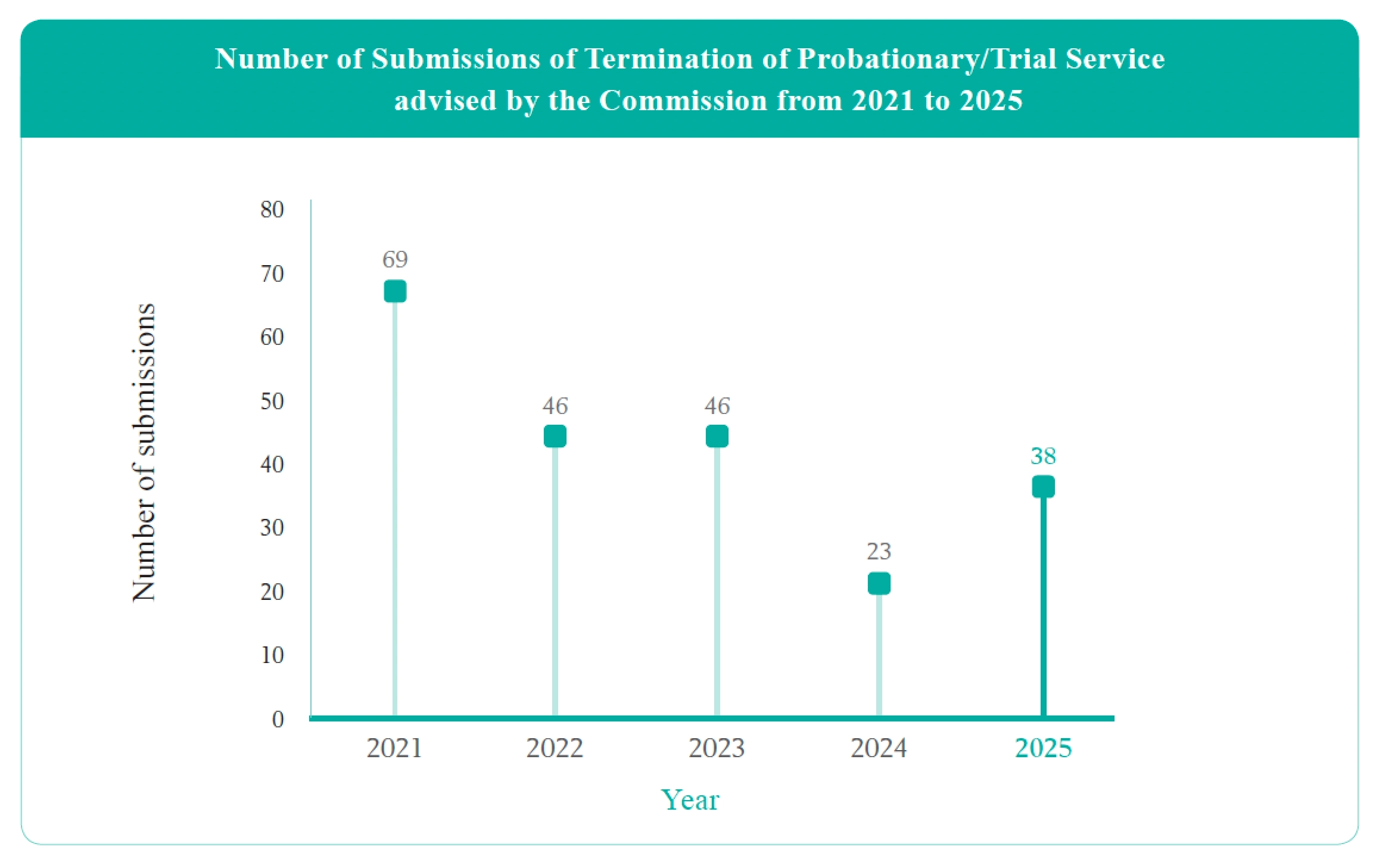
In 2025, the Commission advised on
a total of 38 submissions requiring
the termination of probationary/trial
service of the officers concerned. Most
of these submissions were related to
unsatisfactory performance and/or
conduct.
2.10
There were 110 other submissions
involving extension of probationary/trial service in the year. Most of these
extensions were needed to allow time for
the officers concerned to demonstrate
their suitability for permanent
appointment/passage of trial bar on
grounds of a temporary setback in
performance, minor lapses in conduct,
or pending the acquisition of requisite
qualifications prescribed for continued
appointment. A statistical breakdown of
the submissions related to termination/extension of probationary/trial service
and a comparison with those in the past
four years are provided at Appendix V.
Some observations made by the
Commission on these submissions are
provided in Chapter 3.
2.11
The role of the Commission in advising
the Government on promotions7 in
the Civil Service is to ensure that only
the most suitable and meritorious
officers are selected to undertake the
higher rank responsibilities through a
fair and equitable promotion system.
In examining promotion submissions
from B/Ds, the Commission will need
to be satisfied that proper procedures
have been followed and that the fair
claims of all eligible officers have been
considered on an equal basis, regardless
of their terms of appointment, against the
objective criteria of ability, experience,
performance, character and prescribed
qualifications, if any. The Commission
also makes observations on the conduct of
promotion exercises and matters relating
to performance management with a view
to bringing about improvements as well
as enhancing the efficiency and quality of
the overall civil service promotion system
as a whole.
7
Under the purview of the Commission, recommendations on promotion to middle and senior ranks, i.e. those attracting a
maximum monthly salary not less than the amount specified at Master Pay Scale Point 26 or equivalent, are required to be
submitted to the Commission for scrutiny and advice. The judicial service, the Independent Commission Against Corruption
and the disciplined ranks of the Hong Kong Police Force are outside the purview of the Commission.
2.12
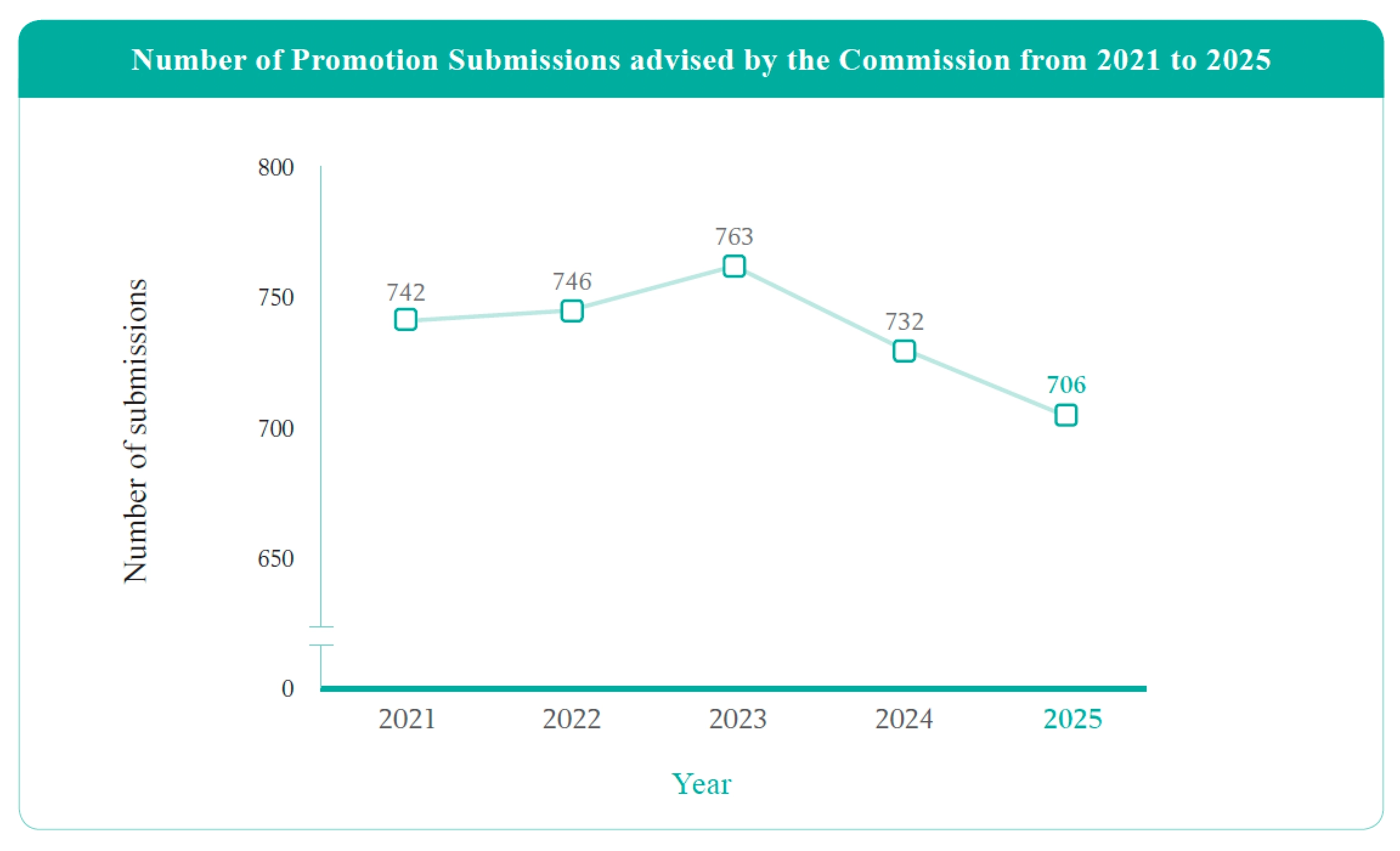
In 2025, the Commission advised on
706 promotion submissions involving
the recommendations of 9 212 officers
for promotion or acting appointment.
The number of promotion submissions
advised by the Commission in the past
five years is shown below –
2.13
Promotions have to be earned on the basis
of merits, and hence are competitive.
The recommendations of a promotion
board have to stand up to scrutiny and the
relevant board has to answer the queries
raised by the Commission and provide
justifications and objective evidence to
support them. A numerical breakdown
of these submissions and a comparison
with those in the past four years are
provided at Appendix VI. Some specific
observations made by the Commission
on these submissions are provided in
Chapter 4.
Extension of Service of Civil Servants
2.14
Pursuant to the Government’s policy
decision announced in January 2015
to extend the service of civil servants,
an adjusted mechanism for further
employment beyond retirement age for
a longer duration than final extension of
service8 (hereafter referred to as “FE”)
was fully implemented from June 2017
after consulting the Commission.
8
A civil servant on permanent terms may apply for a final extension of service for a maximum period of 120 days on operational
or personal grounds beyond his prescribed retirement age subject to any applicable arrangements and criteria prevailing at
the time of the application as may be promulgated from time to time by the Government.
The FE scheme
2.15
Under the FE scheme, eligible officers
may be considered for FE through
a selection process, which has been
institutionalised by making reference to
the modus operandi of promotion and
recruitment boards. The Commission’s
advice is required for FE if the posts
concerned are under our purview. In
2025, the Commission considered 22 FE
submissions and supported the extension
of service of 64 officers. A breakdown
of the number of submissions involving
extension of service or re-employment
after retirement advised by the
Commission in 2025 and a comparison
with those in the past four years are
provided at Appendix VII.
Other Civil Service Appointment Matters
2.16
In 2025, the Commission advised on 54
other appointment submissions. They
cover cases of non-renewal/termination
or extension of agreement; secondment9;
retirement in the public interest under
s.12 of the PS(A)O; review of acting
appointment and updating of Guide
to Appointment (G/A)10. A statistical
breakdown of these submissions and a
comparison with those in the past four
years are provided at Appendix VIII.
9
Secondment is an arrangement to temporarily relieve an officer from the duties of his substantive appointment and appoint
him to fill another office not in his grade on a time-limited and non-substantive basis. Normally, a department will consider a
secondment to fill an office under its charge if it needs skills or expertise for a short period of time and such skills or expertise
are only available from another civil service grade.
10
The G/A is an official document prepared by departments for individual ranks to specify the qualification, requirements
and the terms of appointment for recruitment or promotion to respective ranks. B/Ds are required to update the entry
requirements, terms of appointment, and job description of grades under their purview in the respective G/As on an on-going
basis for CSB’s approval.
Retirement in the public interest under s.12 of the PS(A)O
2.17
Retirement in the public interest under
s.12 of the PS(A)O is not a form of
disciplinary action or punishment but
pursued as an administrative measure in
the public interest on the grounds of –
(a)
persistent sub-standard performance
when an officer fails to reach the requisite
level of performance despite having been
given an opportunity to demonstrate his
worth; or
(b)
loss of confidence when the management
has lost confidence in an officer and
cannot entrust him with public duties.
An officer who is required to retire
in the public interest may be granted
retirement benefits. In the case of a
pensionable officer, a deferred pension
may be granted when he reaches his
statutory retirement age. In the case of
an officer under the CSPF Scheme, on
top of the accrued benefits attributable
to mandatory contributions, which will
not be affected, the accrued benefits
attributable to the Government’s
Voluntary Contributions, if applicable,
will also be payable in accordance with
the rules of the relevant scheme.
2.18
As an initiative to strengthen the
management of persistent sub-standard
performers and expedite the process for
taking the necessary actions, CSB, having
consulted the Commission and collected
views from the management and staff
sides, promulgated the streamlined
mechanism in September 2023.
2.19
In 2025, the Commission was consulted
on two cases under s.12 of the PS(A)O
on the ground of persistent sub-standard
performance out of a total of 18 being
processed by the Government in the
same year11. The Commission had
tendered its advice supporting the
retirement of the officers of the two
cases concerned in the public interest.
These two officers were ordered to retire
in May and August 2025 respectively.
For the remaining 16 cases, two officers
had improved their performance during
the observation period and the s.12
cases were suspended; and 14 officers
remained under close observation or their
s.12 cases were being processed by the
Government as at the end of 2025.
11
Of these 18 cases, one was processed under the mechanism for handling civil servants with persistent sub-standard
performance under s.12 of the PS(A)O modified in 2005, and 17 under the streamlined mechanism promulgated in 2023.
2.20
With the streamlined mechanism
smoothly implemented, it is imperative
for the Government to sustain its
efforts in this regard. Apart from CSB’s
commitment to collaborating closely
with the departmental managements
to enhance the monitoring of potential
and on-going cases of s.12 action, the
Commission will continue to draw
B/Ds’ attention to potential s.12 cases
during the processing of promotion
submissions. We are confident that our
concerted efforts will help uphold the
high standards of the Civil Service and
ensure that cases involving persistent
sub-standard performers are addressed
appropriately and effectively.
Establishing the Heads of Department Accountability System
2.21
The Commission appreciates the
Administration’s dedication to
enhancing the civil service management
system, as well as its on-going efforts
to strengthen governance efficacy. We
are pleased to note the announcement
in the CE’s 2025 Policy Address for the
establishment of a Heads of Department
Accountability System (the System)
and the Government’s contemplation to
expand the Commission’s current role
with a view to enabling it to conduct
the independent investigation work
under Tier II of the System as and when
required. To this end, we understand that
CSB has been working in full steam on
the making of subsidiary legislation under
the PSCO to provide the Commission
with the new investigative function to
undertake Tier II investigation of the
System. We look forward to working
closely with CSB on the preparatory work
for implementing the System.
Strengthening the Performance Appraisal System for Civil Servants
2.22
One of the Commission’s priority tasks
is to collaborate with the Administration
to strengthen the performance
management system in the Civil Service,
aiming to better realise civil servants’
performance and development potential.
Refinements and improvements to the
performance management system are
a continuous process. We are glad to
note that the CE’s 2025 Policy Address
put forward the establishment of a
more rigorous performance appraisal
system for civil servants that seeks to
more effectively reflect and differentiate
the performance levels of staff. We
understand that CSB has commenced the
study on strengthening the civil service
performance appraisal system with a
view to more effectively distinguishing
the staff’s performance level. The
Commission is in full support of this
initiative, and stands ready to contribute
its comments and advice as required.