In a recruitment exercise conducted by a Department, two rounds of selection
interview were held to assess candidates’ suitability for appointment. The Commission
noted that instead of using different criteria in evaluating the candidates, the
Department had adopted exactly the same assessment form and marking scheme in
both rounds of interview. As explained by the Department, it was aimed to have a
more in-depth assessment on the performance of the candidates invited for the second
round of interview.
The Commission expressed concerns that identical assessment criteria across different
rounds of recruitment interview was not an efficient use of resources. Such practice
also begged the question of the distinct purpose for having two rounds of the interview,
undermining the cost-effectiveness of the recruitment process.
The Commission has advised the Department to review its interview arrangements to
ensure that each round of assessment should serve a clear and complementary purpose.
If it is necessary to have a more comprehensive understanding of the candidates’
capabilities, the Department could have included the relevant assessment elements
in a single interview. It should strike a balance between rigorous assessment and
procedural efficiency with a view to upholding the principles of merit, fairness and
cost-effectiveness in civil service recruitment.
Chapter 3
Chapter 3
Recruitment and Management of Officers on Probation/Trial
Recruitment
3.1
Recruiting new talents and injecting
new blood into the Civil Service is
vital in sustaining a stable and robust
workforce to achieve the aim of effective
and efficient delivery of public service
with high quality. B/Ds need to conduct
regular recruitment exercises to meet
their manpower requirements and
service needs. The process of selection
is rigorous and competition is keen.
The Commission supports the conduct
of recruitment based on merit and fair
competition so as to select the best-suited
candidates for the civil service jobs. Apart
from ensuring the proper conduct of
the recruitment process, we also attach
importance to administrative efficiency
so that the Government can compete
with the market for talents and good
candidates.
Recruitment Submissions Advised in 2025
3.2
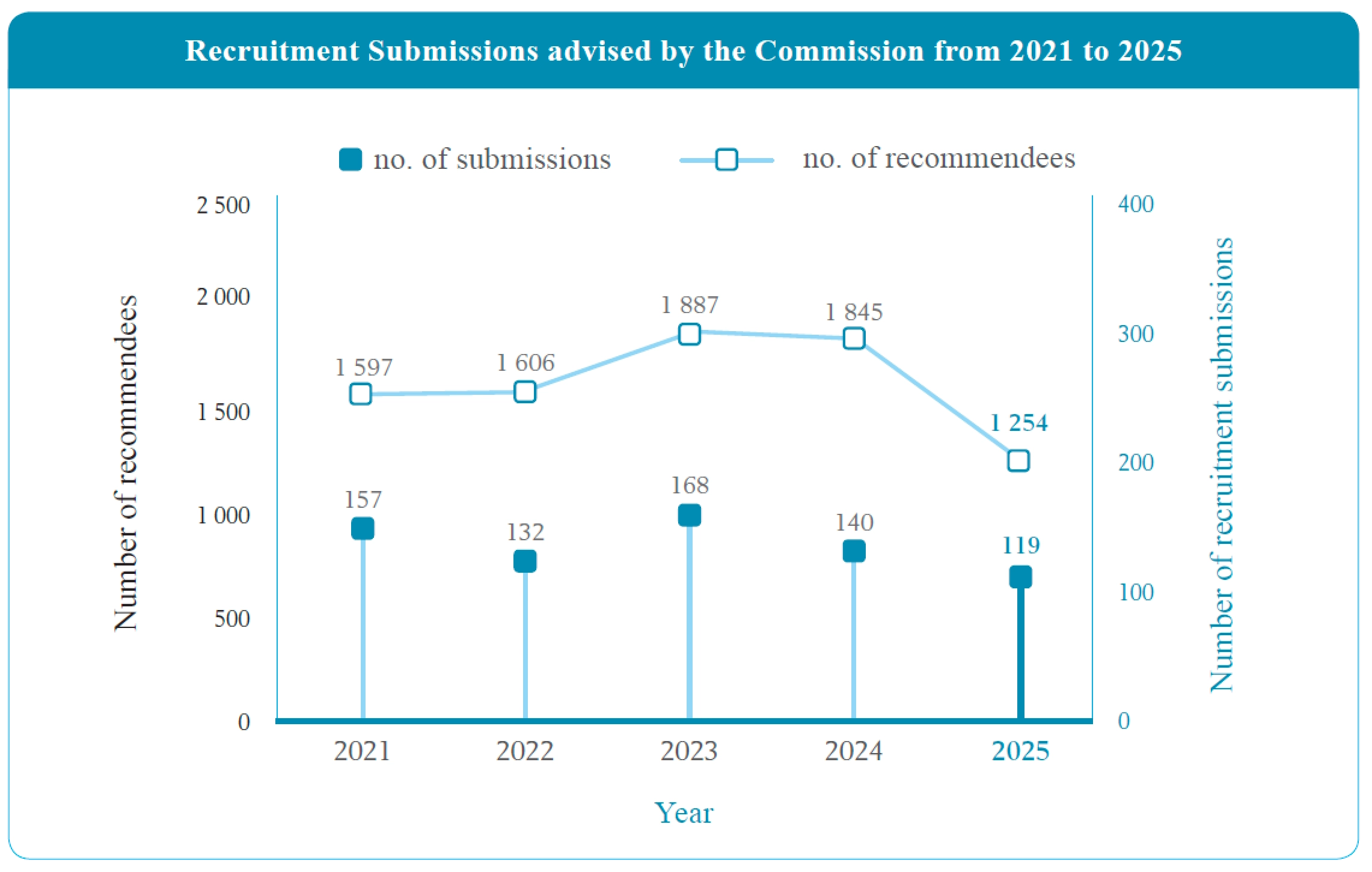
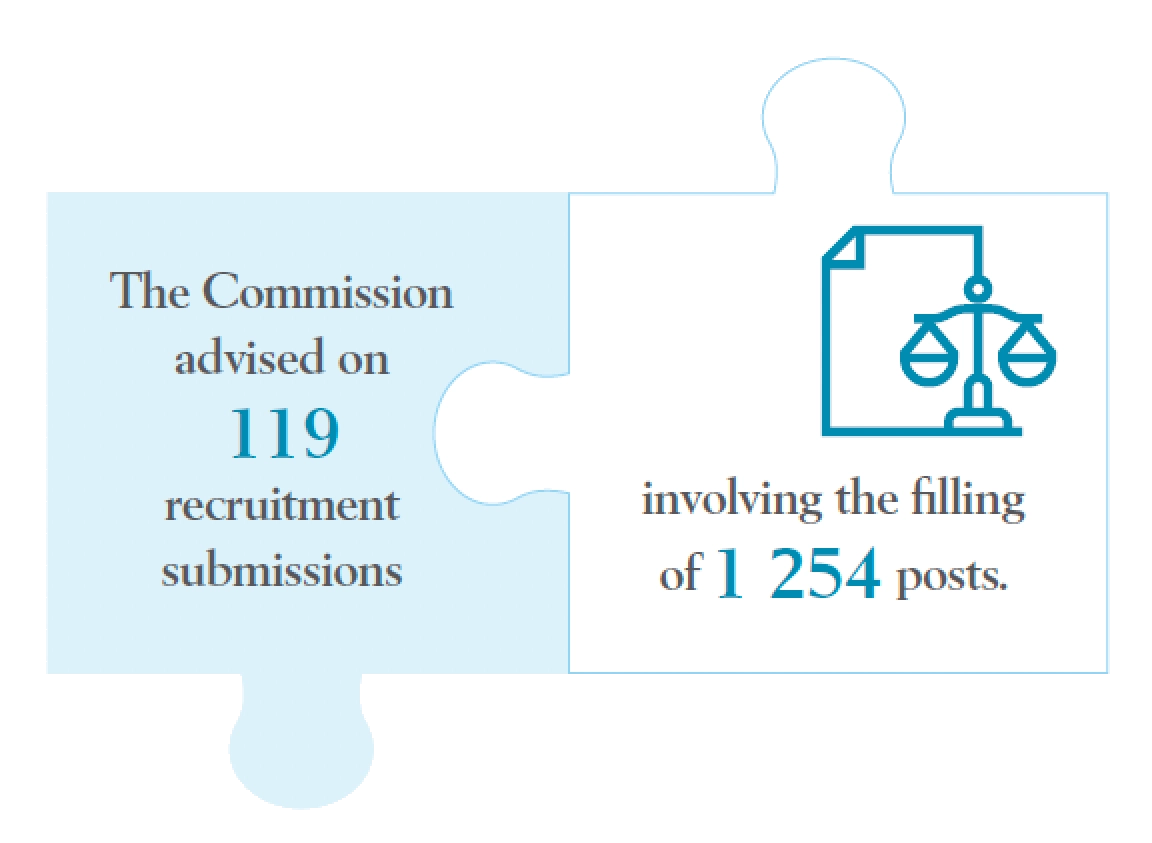
In 2025, the Commission advised on
119 recruitment submissions. With
years of experience and clear guidelines
in place, the Commission was pleased
to note that B/Ds had been expediting
the recruitment process in general,
and recruitment exercises had been
conducted in a largely smooth and
effective manner. They had also adhered
to civil service policies and rules in
conducting the recruitment exercises,
making appropriate preparations by
planning and conducting recruitment
exercises in advance of anticipated
wastage. The number of recruitment
submissions advised by the Commission
in the past five years is shown below –
Quality of Recruitment Reports
3.3
During the year, the Commission was
also delighted to see that a number
of departments had submitted board
reports of outstanding quality on their
recruitment exercises. In each of their
submissions, the recruitment boards
concerned had provided pertinent
information and well-reasoned
assessments of individual candidates’
performance, along with a clear
and concise account of the boards’
deliberations. The Commission’s
scrutiny of the recommendations
was greatly facilitated and efficiency
enhanced.
3.4
However, the quality of write-ups on
interviewees in board reports from some
departments remained inadequate,
with the comments on individual
interviewees overly brief and generic,
making it difficult to distinguish their
performance. Although the ratings
and scores given were clear and the
results unaffected, the Commission has
advised the relevant Departments to
remind future recruitment boards to
provide more specific comments in the
written assessments to clearly reflect
the performance of candidates so as to
support the boards’ recommendations.
3.5
The Commission also observed that
the information contained in some
board reports was not accurate,
with the scores of candidates being
erroneously inputted. While corrections
were made upon our enquiry and
the overall recommendations of the
recruitment exercise remained intact,
the Commission has reminded the
Departments concerned to remain
vigilant and thoroughly check the
accuracy of all information in the board
reports before submitting them to the
Commission for advice.
Efficiency of recruitment process
3.6
The Commission has all along advocated
the need to conduct and complete
recruitment exercises expeditiously
without delay. It is imperative for B/Ds
to prepare well and make adequate
plans for each stage of their recruitment
exercises so that vacancies can be filled
at the earliest opportunity. B/Ds are also
encouraged to regularly review their
recruitment frameworks to identify
improvements that enhance efficiency
without compromising the standard of
assessment of candidates.
3.7
During the year, the Commission
observed areas for improvement in
the recruitment arrangements of some
Departments which had undermined
recruitment efficiency. Cases 3A and 3B
illustrate our observations and advice in
this respect.
Case 3A
Case 3B
In a year-round recruitment exercise, it came to the Commission’s attention that
the processing of an application from a candidate with disability had spanned over
two years. The Department explained that the long processing time was due to the
difficulty in obtaining the necessary documentary proofs from the applicant to support
his request for special arrangements in attending written examination and selection
interview.
Appreciating that the Department had erred on the prudent side to make special arrangements only when the disability status was ascertained beyond doubt, the Commission has advised the Department to achieve greater efficiency by communicating with the applicant concerned more proactively to obtain the necessary proofs. In case the validity of the proofs provided by the applicant is doubtful, the Department should consult CSB promptly to facilitate timely and concrete arrangements, thus avoiding any unnecessary delays.
Appreciating that the Department had erred on the prudent side to make special arrangements only when the disability status was ascertained beyond doubt, the Commission has advised the Department to achieve greater efficiency by communicating with the applicant concerned more proactively to obtain the necessary proofs. In case the validity of the proofs provided by the applicant is doubtful, the Department should consult CSB promptly to facilitate timely and concrete arrangements, thus avoiding any unnecessary delays.

Time is of the essence when handling recruitment exercises so that manpower
gaps could be bridged seamlessly to sustain quality public service.
Management of Officers on Probation/Trial
3.8
As pointed out in Chapter 2, in
determining the suitability of officers
on probation/trial to continue to hold
office, HoDs/HoGs should apply
stringent standards in assessing their
performance and conduct. To uphold
the high standards of the Civil Service,
it is imperative that only officers who
are suitable in all respects are allowed to
pass the probation/trial bar for continued
appointment.
Assessment of suitability for passage of probation/trial bar
3.9
The Commission noted that B/Ds have in
general been vigilant in applying stringent
standards in assessing an officer’s
suitability for passage of the probation/trial bar. However, the Commission
was concerned that a Department
had much room for improvement in
its management of probationers with
persistent unsatisfactory performance, as
exemplified in Case 3C.
Case 3C
A verbal warning was meted out to an officer towards the end of his three-year
probation due to a duty-related misconduct which was relatively minor in nature. In
scrutinising the Department’s proposal to defer his passage of probation bar following
the warning, the Commission noted that most of his appraisals during the probationary
period were rated “4 – Moderate” on a six-tier rating scale with adverse remarks in his
performance and unimpressive core competencies. Notably, in his last probationary
report (also rated “4”) completed prior to the misconduct case, the Appraising Officer
(AO) recommended him for passage of probation bar despite his shaky performance.
Worse still, the Countersigning Officer (CO) indicated in the appraisal that he
“reluctantly” agreed to such recommendation without a critical review of the AO’s
assessment on the officer’s suitability for passage of probation bar. Similarly, the
Reviewing Officer concurred with the AO’s and CO’s observations without pointing
out their ungrounded recommendations.
Given the probationer’s persistent unsatisfactory performance, the Commission had reminded the Department to critically assess his suitability to pass the probation bar. Ultimately, the Department, after review, issued a letter-of-intent to the probationer concerned informing him of the intention to refuse his passage of probation bar. The officer later resigned from the service.
To avoid recurrence of similar cases in future, the Commission has strongly urged the Department to take the following actions –
Given the probationer’s persistent unsatisfactory performance, the Commission had reminded the Department to critically assess his suitability to pass the probation bar. Ultimately, the Department, after review, issued a letter-of-intent to the probationer concerned informing him of the intention to refuse his passage of probation bar. The officer later resigned from the service.
To avoid recurrence of similar cases in future, the Commission has strongly urged the Department to take the following actions –
(a)
the Department should remind the reporting officers concerned of their
responsibilities to fulfill their roles properly and provide sound justifications when
making/agreeing to recommendations on an officer’s passage of probation bar;
(b)
should a probationer fail to measure up to the required standards of performance,
despite guidance and coaching, at any time during the probationary period, the
Department should take appropriate and prompt performance management
actions, such as issuing advisory letters, calling special progress reports, arranging
stoppage of increment; and
(c)
confirmation of probationers to the permanent establishment should not be taken
lightly and stringent suitability standards should be upheld when considering their
suitability for passage of probation bar.
To ensure the integrity and effectiveness of the administration of the probation/trial system, it is imperative for B/Ds to consistently enforce stringent
standards, exercise due diligence at all times, and take decisive actions when
the performance of probationers or officers on trial falls below expected levels.
Taking prompt and expeditious action in handling cases involving probationers
3.10
As required under CSR186(4),
recommendations involving extension
or termination of probationary service,
which fall under the purview of the
Commission, should as far as practicable
be submitted to the Commission at
least two months before the end of the
probationary period.
3.11
In 2025, the Commission observed that
a Department had repeatedly failed
to handle cases involving probationers
promptly and timely, leading to
unacceptable delays in its submissions to
the Commission. The cases depicted in
3D are relevant.
Cases in 3D
The Department had come to the view of refusing an officer’s passage of probation
bar due to his conduct issues. After reviewing the officer’s representations against
the intended refusal, the Department decided to uphold its view. However, the
Department took more than five months to submit the recommendation to the
Commission.
In another submission, the Department proposed to defer the passage of probation bar of three officers due to their suspected involvement in misconduct cases, the investigation of which had been on-going. However, we noted that the Department’s submission was delayed by up to six months from the officers’ due dates for passage of the probation bar, even though their alleged acts of misconduct had been revealed either before or shortly after those due dates.
In another case, the complaints management section of the Department referred a suspected criminal incident involving a probationer to law enforcement agencies (LEAs) in April 2025 for investigation. Considering that the officer was due to pass the probation bar in October 2025 and that it would not be possible to clear his integrity doubts pending the on-going investigation of the LEAs, the GM should have submitted its proposal to extend his probationary service in good time. However, as the GM only became aware of the officer’s involvement in the on-going investigation about five months after the referral, it only submitted the case to the Commission in November 2025, well beyond the due date for passage of the officer’s probation bar.
The Commission expressed serious concerns about such delays, which undermine the punitive and deterrent effects, weaken the credibility of the disciplinary system, as well as compromise the Government’s resolve to uphold a meritorious Civil Service. The Commission has brought the unsatisfactory handling of these cases to the attention of the Department’s senior management.
While the Department has undertaken to implement measures to improve the situation, the Commission has asked it to constantly review the effectiveness of the measures taken/to be taken, and refine them when necessary. We have also advised the Department to review its workflow and enhance its internal communication to ensure that prompt and appropriate actions should be taken on probationers with performance and/or conduct issues.
In another submission, the Department proposed to defer the passage of probation bar of three officers due to their suspected involvement in misconduct cases, the investigation of which had been on-going. However, we noted that the Department’s submission was delayed by up to six months from the officers’ due dates for passage of the probation bar, even though their alleged acts of misconduct had been revealed either before or shortly after those due dates.
In another case, the complaints management section of the Department referred a suspected criminal incident involving a probationer to law enforcement agencies (LEAs) in April 2025 for investigation. Considering that the officer was due to pass the probation bar in October 2025 and that it would not be possible to clear his integrity doubts pending the on-going investigation of the LEAs, the GM should have submitted its proposal to extend his probationary service in good time. However, as the GM only became aware of the officer’s involvement in the on-going investigation about five months after the referral, it only submitted the case to the Commission in November 2025, well beyond the due date for passage of the officer’s probation bar.
The Commission expressed serious concerns about such delays, which undermine the punitive and deterrent effects, weaken the credibility of the disciplinary system, as well as compromise the Government’s resolve to uphold a meritorious Civil Service. The Commission has brought the unsatisfactory handling of these cases to the attention of the Department’s senior management.
While the Department has undertaken to implement measures to improve the situation, the Commission has asked it to constantly review the effectiveness of the measures taken/to be taken, and refine them when necessary. We have also advised the Department to review its workflow and enhance its internal communication to ensure that prompt and appropriate actions should be taken on probationers with performance and/or conduct issues.
When handling cases involving probationers, B/Ds must swiftly address issues
related to performance and conduct, continuously enhance their operational
processes, and maintain effective communication to ensure timely actions and
uphold the principles of merit within the Civil Service.