In one Department, the opt-out rates of two ranks of a grade had consistently ranged
between 25% and 40% over the past three consecutive years. In another Department,
the opt-out rate of a specific rank of a grade increased from 17% in 2023 to 20% in
2024, before moderating to 18% in 2025. Besides, in a different Department, although
the average opt-out rate of a rank of a grade had remained at about 10% over the past
three years, the absolute number of officers opting out was not small, ranging from 24
to 28 annually.
While the officers concerned usually indicated their wish of not being considered for
advancement owing to personal or health reasons, the phenomenon of persistently high
opt-out rates clearly suggested a need for the relevant GMs to delve deeper into the
underlying causes and implement more targeted measures to motivate eligible officers
to pursue their career advancement.
Regular engagement with grade members will enable the GMs to ascertain the reasons
behind the lack of aspiration of the officers concerned. It is also imperative for the GMs
to provide suitable training and posting to their staff so as to broaden their exposure
and better prepare them for higher responsibilities. Such strategies will encourage
more officers to take up advancement opportunities, thereby fostering a more robust
succession planning.
The Commission has advised the GMs concerned to address the issue of low aspiration
among their grade members and looks forward to improvement in near future.
Chapter 4
Chapter 4
Promotion and Human Resource Management 
4.1
Promotion is a well-established
mechanism for filling vacancies at the
higher ranks in the Civil Service. It
also provides opportunities for civil
servants to develop their career and
make advancement which is conducive
to staff succession and smooth operation
in their B/Ds. Premised on the principles
of meritocracy and fair competition,
promotion has to be earned. It is neither
an entitlement nor a reward for long
service. The Commission advises and
assists the Government to ensure that
deserving officers are promoted through
a transparent and fair selection process.
Promotion Submissions Advised in 2025
4.2
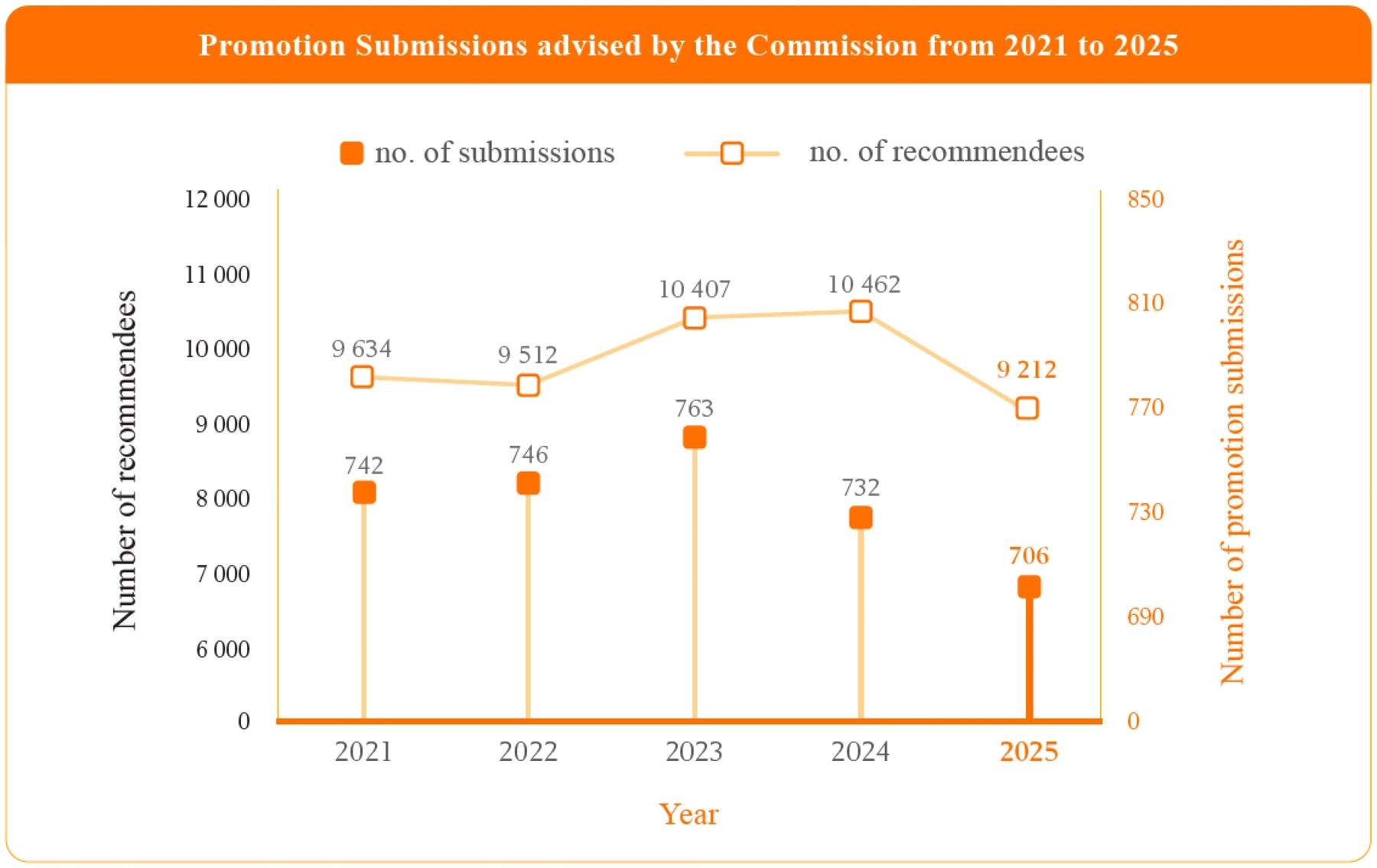
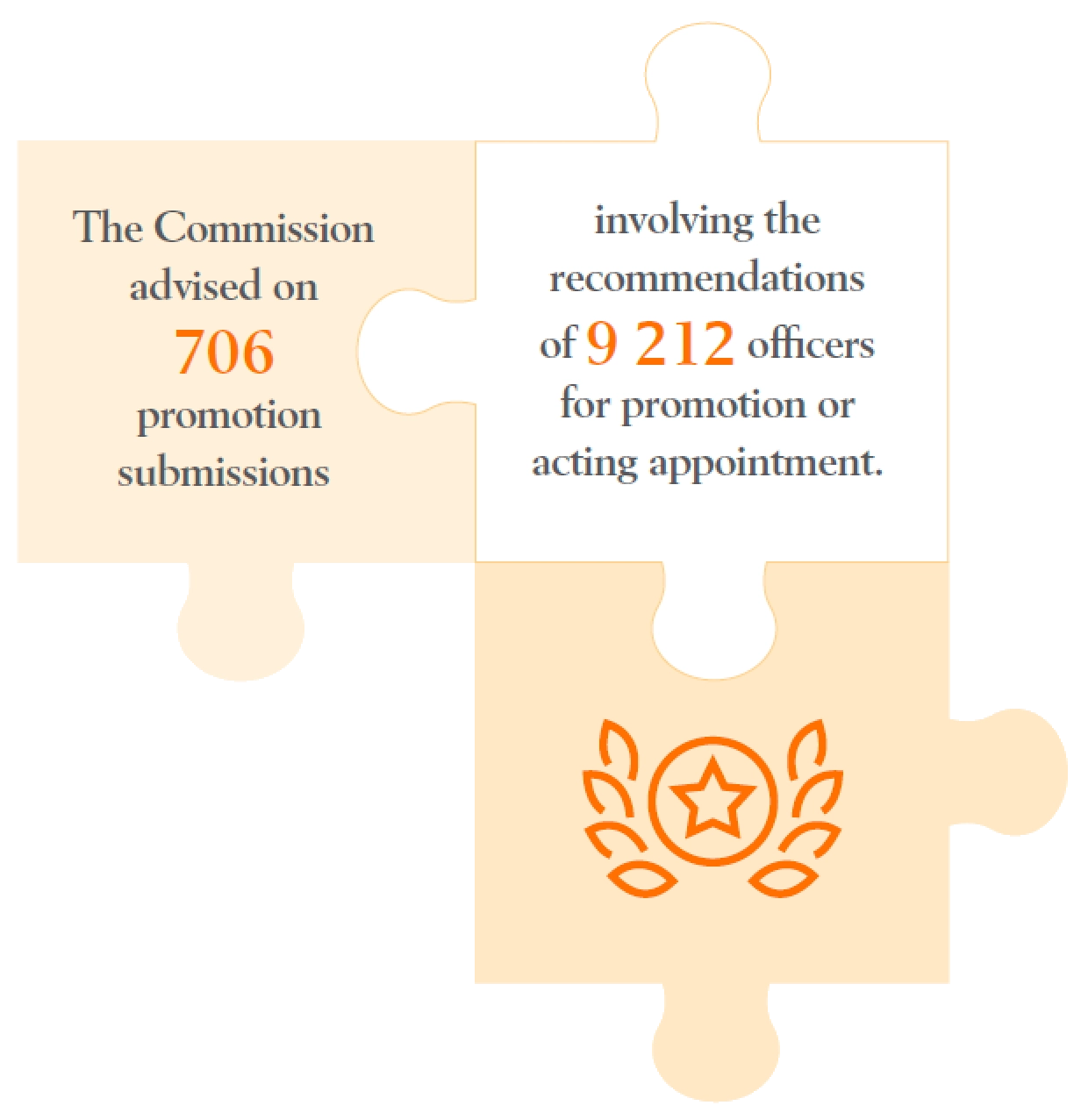
In 2025, the Commission advised
on 706 promotion submissions. The
promotion submissions were largely
clear and well-written. The Commission
was also pleased to note the continued
maintenance of general compliance with
the relevant CSRs, as well as prescribed
rules and procedures by B/Ds. The
number of promotion submissions
advised by the Commission in the past
five years is shown below –
4.3
The first and foremost task of a
promotion/selection board is to
ascertain the total number of vacancies
available for promotion and/or acting
appointments. Miscalculation of
vacancies is clearly not in the operational
interest of B/Ds nor the career interest of
the officers concerned. Paragraph 3.5(a)
of the Guidebook on Appointments (the
Guidebook) issued by CSB sets out the
principles in determining the number
of promotable and acting vacancies in a
promotion exercise. As far as promotable
vacancies are concerned, the guiding
principles are –
(a)
those expected to arise within the current
reporting cycle should be counted as
promotable vacancies; and
(b)
time-limited posts should be counted
as promotable vacancies if sufficient
permanent vacancies will become
available to absorb the promotees before
the lapse of the time-limited posts
concerned. There is no restriction on how
far ahead a corresponding permanent
vacancy should be anticipated for it to be
so used in a promotion exercise.
4.4
During the year, most B/Ds were able
to follow the guiding principles above
in calculating promotable vacancies.
However, the Commission found
miscalculations in the submissions
made by three Departments due to
their failure to realise that future
permanent vacancies could be used to
absorb the promotees before the lapse
of their time-limited posts. In response
to the Commission’s enquiries, the
Departments reviewed and updated
their vacancy situations, enabling
the effective dates of the promotion
of the recommended promotees to
be advanced to earlier dates, where
appropriate. The Commission has
reminded the Departments concerned to
closely observe the relevant guidelines
in counting promotable vacancies
and to urge the subject officers to
fully familiarise themselves with such
guidelines in future.
4.5
According to paragraph 3.46 of the
Guidebook, B/Ds should submit
promotion board reports to the
Commission for advice within two
months after the board meetings.
Late submission is not conducive to
maximising staff resources for the
operation of B/Ds. It will also affect
their manpower development plans
and posting arrangements for officers
identified as suitable for promotion/acting.
4.6
During the year, the Commission was
generally satisfied with B/Ds’ overall
adherence to the timing requirement
for submitting promotion board reports.
However, we observed that in 2025,
there were still some late submissions, for
example, one Department had submitted
four promotion board reports late in a
row. The Department had taken three
to four months to submit these reports
after the respective board meetings. The
main reasons for such delays included
changes in personnel for preparing board
reports and clustering of other promotion
exercises. While appreciating the heavy
commitments of the subject officers,
late submission of promotion board
reports may disrupt the timetables for
staff postings and/or career development
plans. The Commission has strongly
advised the Department concerned to
make better work plans and ensure timely
submission of board reports in future.
4.7
Human Resource Management (HRM)
is a planned and strategic approach to
managing staff performance. Good HRM
practices are instrumental in helping
achieve corporate goals as well as enhance
service productivity and quality. In
the process of examining promotion
submissions, the Commission will give
advice on HRM practices adopted by
B/Ds when inadequacies are observed.
Some specific observations made by the
Commission in the ensuing paragraphs
are provided as a reference for B/Ds.
Optimal use of available vacancies
4.8
Promotion is a recognition given
to deserving officers who have
demonstrated their capability and
suitability in all respects for assuming
more demanding responsibilities at
the higher ranks. It also serves as an
incentive for officers with aspiration to
strive for continuous improvement. It is
imperative for promotion boards to make
optimal use of the available vacancies to
promote deserving officers at the earliest
possible opportunity so as to –
(a)
realise the potential of capable officers;
(b)
meet staff expectations; and
(c)
better motivate staff.
4.9
Apart from the need to count the number
of promotable vacancies accurately in
accordance with the guidelines stipulated
in the Guidebook as mentioned in
paragraph 4.3 above, the Commission is
also concerned whether B/Ds have made
the optimal use of available vacancies.
In the last two Annual Reports, the
Commission raised its concerns over a
persistent problem in two Departments
of leaving a considerable number of
vacancies at promotion ranks unfilled
despite the availability of eligible and
capable officers.
4.10
While acknowledging the intricacies
of the problem are manifold and the
reasons behind each case may be
unique, leaving vacancies unfilled in
the promotion process is not conducive
to staff development, succession
planning and staff morale. Taking heed
of the Commission’s advice, the two
Departments had positively responded
and made marked improvement in filling
the higher rank vacancies in 2024 as
reported in the last Annual Report. The
Commission was pleased to note that the
two Departments had achieved further
improvement in 2025, as illustrated in
Cases 4A and 4B.
Case 4A
In a Department, the percentage of unfilled vacancies for two ranks of a grade had
exceeded 50% of the total number of available vacancies upon conclusion of the 2023
promotion exercises. In response to the Commission’s concerns, the percentage of
unfilled vacancies for both ranks had decreased to about 35% in 2024. Taking heed
of Commission’s advice for making further improvement, the two promotion boards
conducted in 2025 had identified more eligible and meritorious officers for testing at
the higher ranks. As a result, the percentages of unfilled vacancies for the two ranks
had further reduced to 15% and 25% respectively. The Commission is glad to note that
the Department has undertaken to further lower the percentage of unfilled vacancies
to below 10% in the coming few years.
To fill the temporary manpower gaps, while the Department still arranged some unrecommended officers to fill the higher rank vacancies through short-term acting appointments, we note that such acting appointments were arranged with full justifications and in compliance with the relevant CSRs. The Commission also noted that some improprieties of intermittent acting appointments identified had been rectified by the Department.
We commended the efforts made by the Department and encouraged it to keep up its good work.
To fill the temporary manpower gaps, while the Department still arranged some unrecommended officers to fill the higher rank vacancies through short-term acting appointments, we note that such acting appointments were arranged with full justifications and in compliance with the relevant CSRs. The Commission also noted that some improprieties of intermittent acting appointments identified had been rectified by the Department.
We commended the efforts made by the Department and encouraged it to keep up its good work.
Case 4B
In another Department, the percentage of unfilled vacancies of its three promotion
exercises conducted in 2023 had ranged from 15% to 50% of the total number of
available vacancies at the respective ranks. With the Department’s continuous efforts
and implementation of a series of HRM measures to enlarge the pool of eligible
candidates, the promotion boards conducted in the subsequent two years in 2024 and
2025 were able to identify a sufficient number of suitable candidates to fill the higher
rank vacancies.
To sustain its efforts to fill up the available promotable vacancies, the Department was responsive to the Commission’s advice to enlarge the pool of eligible candidates. It had put in place augmented measures to encourage and facilitate its grade members to attain the requisite training requirements for advancement, such as drawing up a more robust training plan as well as arranging extra and designated training classes. In 2025, there was a notable increase in the number of eligible candidates in the relevant ranks, with one case having more than 100 officers attaining the requisite training requirements as compared to that in 2024. While we acknowledged the Department’s good work done, we look forward to its continued efforts in maintaining a healthy and dynamic succession in the grades concerned.
To sustain its efforts to fill up the available promotable vacancies, the Department was responsive to the Commission’s advice to enlarge the pool of eligible candidates. It had put in place augmented measures to encourage and facilitate its grade members to attain the requisite training requirements for advancement, such as drawing up a more robust training plan as well as arranging extra and designated training classes. In 2025, there was a notable increase in the number of eligible candidates in the relevant ranks, with one case having more than 100 officers attaining the requisite training requirements as compared to that in 2024. While we acknowledged the Department’s good work done, we look forward to its continued efforts in maintaining a healthy and dynamic succession in the grades concerned.
4.11
Apart from the two Departments in
Cases 4A and 4B above, the Commission
was glad to note that another
Department had identified the crux of
the high vacancy problem and adopted
a multi-pronged approach to address it.
Progressive improvement was observed
as illustrated in Case 4C below.
Case 4C
A Department had previously failed to identify a sufficient number of candidates for
filling vacancies at the first promotion rank of a grade in consecutive exercises. Noting
the Commission’s concerns, the Department had stepped up its staff development
measures and provided vocational training with a view to developing the potential
officers at the entry rank, and equipping them with the knowledge and skills required
of the next higher rank. As a result, more competent officers could be nurtured to take
up higher responsibilities.
With the Department’s efforts starting to pay off, the promotion board conducted in 2025 was able to identify more eligible and meritorious officers for testing at the higher rank. As a result, the percentage of unfilled vacancies was substantially trimmed to below 20% of the total number of available vacancies, as compared to 30% in the past few exercises.
The Commission was pleased to see the positive result, and had encouraged the Department to keep up with its efforts to fill the vacancies as far as possible for meeting the succession needs of the grade in the long run.
With the Department’s efforts starting to pay off, the promotion board conducted in 2025 was able to identify more eligible and meritorious officers for testing at the higher rank. As a result, the percentage of unfilled vacancies was substantially trimmed to below 20% of the total number of available vacancies, as compared to 30% in the past few exercises.
The Commission was pleased to see the positive result, and had encouraged the Department to keep up with its efforts to fill the vacancies as far as possible for meeting the succession needs of the grade in the long run.

Through proactive staff development and vocational training, challenges are
transformed into opportunities, significantly enhancing officers’ readiness for
advancement and reducing unfilled vacancies.
Limitations in training capacity
4.12
The Commission noted that in a number
of cases, the high vacancy rate at the
promotion ranks had been attributable
to the limited number of officers who
could meet the stipulated prerequisite
requirements for promotion. While
the Department in Case 4B was able to
make improvement by implementing
different measures to facilitate its grade
members to attain the requisite training
requirements for advancement, the high
vacancy rates in two other Departments
had been due to insufficient training
capacity for the specific professional
training to enable candidates to
obtain the requisite qualifications for
promotion. This problem continues to
be challenging, as illustrated in Cases 4D
and 4E.
Case 4D
The promotion boards for one rank of a grade had not identified an adequate number
of officers to fill all available vacancies in the past few years. The problem persisted in
2024, with over 60% of the higher rank vacancies left unfilled. The major reason was the
limited number of eligible officers who could successfully complete the departmental
training and obtain the requisite qualifications for progression to the higher rank.
Taking heed of the Commission’s advice, the Department conducted a review and adopted a multi-pronged approach in resolving the problem. In addition to revamping and enhancing the training progression plans for the grade members, the Department strengthened its training capacity through engaging additional training resources from the market and exploring the use of new technology. The Department further enhanced the monitoring system in keeping track of officers’ progress throughout various stages of training, as well as providing them with periodic assessments and timely guidance.
The Commission was pleased to note that the measures adopted by the Department had yielded initial positive results in 2025, with the vacancy rate of the rank concerned reduced by about 10% as compared with that in 2024. The Commission looks forward to the lowering of unfilled vacancies further with the increased number of officers attaining the prescribed qualification for promotion in the coming years.
Taking heed of the Commission’s advice, the Department conducted a review and adopted a multi-pronged approach in resolving the problem. In addition to revamping and enhancing the training progression plans for the grade members, the Department strengthened its training capacity through engaging additional training resources from the market and exploring the use of new technology. The Department further enhanced the monitoring system in keeping track of officers’ progress throughout various stages of training, as well as providing them with periodic assessments and timely guidance.
The Commission was pleased to note that the measures adopted by the Department had yielded initial positive results in 2025, with the vacancy rate of the rank concerned reduced by about 10% as compared with that in 2024. The Commission looks forward to the lowering of unfilled vacancies further with the increased number of officers attaining the prescribed qualification for promotion in the coming years.
Case 4E
The situation of another Department was even more challenging. The unfilled
vacancies for two ranks of a grade remained substantial in 2025, exceeding 50% of the
total number of available vacancies in both ranks.
Similar to Case 4D, officers need to undergo and pass the training prescribed and conducted by the Department so as to be qualified for consideration for promotion to the higher ranks. As explained by the Department, one of the major causes for the high vacancy rates is insufficient manpower for in-house training, which is necessary due to its unique operational needs, to create a sufficiently large pool of qualified officers.
On closer examination, the Commission noted that such a limitation was mainly resulted from the senior experienced officers in the Department, who should assume the training duties, being engaged in a wide range of non-core duties, largely administrative in nature. Another challenge is that there was a number of resignations in previous years resulting in further drain of eligible candidates for consideration of advancement.
At the Commission’s request, the Department conducted a detailed review of its operation and formulated effective measures to cope with the challenges. The measures included enhancement of administrative support for releasing the in-house qualified trainers from non-core duties, engagement of additional external trainers on contract terms as well as implementation of strategies to retain staff. With the implementation of these measures, the Department expected to have improved training capacity and a long-term solution to its vacancy issue in the coming five years.
While appreciating the efforts made by the Department, the Commission has urged its senior management to remain vigilant. In addition, we have requested the Department to submit a progress report in 2026 reporting on the implementation and effectiveness of its various measures. The Commission anticipates that there will be improvement in the vacancy rates of the grade as committed by the Department.
Similar to Case 4D, officers need to undergo and pass the training prescribed and conducted by the Department so as to be qualified for consideration for promotion to the higher ranks. As explained by the Department, one of the major causes for the high vacancy rates is insufficient manpower for in-house training, which is necessary due to its unique operational needs, to create a sufficiently large pool of qualified officers.
On closer examination, the Commission noted that such a limitation was mainly resulted from the senior experienced officers in the Department, who should assume the training duties, being engaged in a wide range of non-core duties, largely administrative in nature. Another challenge is that there was a number of resignations in previous years resulting in further drain of eligible candidates for consideration of advancement.
At the Commission’s request, the Department conducted a detailed review of its operation and formulated effective measures to cope with the challenges. The measures included enhancement of administrative support for releasing the in-house qualified trainers from non-core duties, engagement of additional external trainers on contract terms as well as implementation of strategies to retain staff. With the implementation of these measures, the Department expected to have improved training capacity and a long-term solution to its vacancy issue in the coming five years.
While appreciating the efforts made by the Department, the Commission has urged its senior management to remain vigilant. In addition, we have requested the Department to submit a progress report in 2026 reporting on the implementation and effectiveness of its various measures. The Commission anticipates that there will be improvement in the vacancy rates of the grade as committed by the Department.
Adopting innovative and proactive approaches to tackle manpower challenges
is instrumental in constructing a pool of talents, ensuring sustainability, and
meeting future operational demands.
Persistent high opt-out rates in promotion exercises
4.13
In some cases, the percentage of unfilled
vacancies would aggravate due to
individuals opting out in promotion
exercises, leading to a reduced number of
eligible officers for consideration. While
specific grade or rank may implement
opt-out arrangement where there is
special ground, persistently high opt-out
rates can hinder the timely filling
of senior positions and undermine
the effectiveness of the merit-based
promotion system.
4.14
During the scrutiny of promotion
submissions, the Commission was
concerned about the phenomenon of
high opt-out rates persisting in several
grades for some years, implying the need
for proactive management actions. The
cases depicted in 4F are relevant.
Cases in 4F
Persistently high opt-out rates underscore the need for proactive career
management. By aligning strategies with officers’ career aspirations, we
can motivate them to pursue career growth, ensuring a Civil Service that is
responsive to future challenges.
Performance management
4.15
Performance management is an essential
element in HRM. Heads of Department/Heads of Grade (HoDs/HoGs) have the
overall responsibility to ensure that the
performance management system for
the staff members/grades under their
purview functions effectively, and there
is timely, accurate, comprehensive,
candid and objective reporting of staff
performance. Both over-generous and
over-stringent reporting distort the
performance management objectives.
4.16
In 2025, the Commission was pleased to
note that in a few cases, the Departments
had taken progressive actions to
monitor the assessment standards in
response to the Commission’s concerns
and have successfully improved the
over-generous reporting situation.
However, the tendency of rating the
overall performance of a great majority
of eligible officers at the top level still
persisted in some departments.
4.17
Separately, the Commission noted that
some departments had the tendency
of rating most officers at the same
level. For example, in the promotion
submissions of several grades in two
Departments, over 95% of eligible
officers received identical ratings
on their overall performance and/or
promotability. Although performance
and promotability ratings should not
be taken and read in isolation but
in totality with the detailed written
assessment, ranking the performance and
promotability of most eligible officers at
the same level will make it difficult to
identify real performers and to support
the promotion boards’ recommendations
on the basis of the officers’ performance
records. The Commission has urged these
Departments to step up their efforts to –
(a)
review the assessment standards where necessary;
(b)
implement measures to remind
supervising officers of the importance of
fair, candid and well-justified reporting,
and arrange for them to attend relevant
training on performance management;
and
(c)
monitor and review the effectiveness of the measures from time to time.
4.18
As mentioned in the 2024 Annual
Report, we were pleased to note that
on the Commission’s advice and with
CSB’s ongoing efforts, all B/Ds had
adopted the standard six-tier rating
scale for overall grading in the appraisal
reports of major grades and ranks, thus
achieving consistency in performance
assessment within the Government.
However, the Commission observed that
the rating scale used by some B/Ds to
assess officers’ promotability, including
descriptions such as “exceptionally
well fitted”, “well fitted”, or “fitted” for
promotion, is subject to considerable
room for interpretation. This type of
promotability rating cannot clearly
indicate officers’ demonstrated
readiness for higher responsibilities.
At the Commission’s request, CSB has
followed up with the relevant B/Ds to
review and refine the rating scale and
assessment standards for promotability,
aiming to develop a clearer and more
precise framework that better reflects an
appraisee’s readiness and suitability for
advancement or acting appointments.
While noting the good progress made in
2025 with the rating scale already revised
in a number of B/Ds, we look forward to
the further progress on this front.
4.19
The appraisal system in the Civil
Service is a three-tier structure under
which the Appraising Officers (AOs),
Countersigning Officers (COs) and
Reviewing Officers (ROs) are required
to make their timely, candid and
independent assessments based on facts
and observations. This is to ensure a
multi-perspective assessment on an
appraisee. In 2025, the Commission
noted deviations from the three-tier
appraisal system in the completion
of appraisal reports as illustrated in
Case 4G.
Case 4G
A Department had improperly arranged a single reporting officer to concurrently
assume the roles of AO, CO, and RO in completing appraisal reports. As explained
by the Department, this was due to the fact that the CO concerned, who was also
the RO for the rank, had been on pre-retirement leave. This arrangement was a clear
deviation from the prevailing guidelines, which stipulate that the roles of AO, CO, and
RO should be assumed by different officers as far as practicable. At the Commission’s
request and in consultation with CSB, the Department subsequently rectified this
arrangement by engaging different officers to assume the assessment roles in the
appraisals concerned.
Having one officer assuming all the roles of AO, CO, and RO in an appraisal report was unsatisfactory and exposed apparent inadequacies in the Department’s performance management practices. While the Commission noted that this happened under exceptional circumstances, the Commission seriously reminded the Department to comply with the guiding principles of the performance management system when arranging the completion of appraisal reports in the future.
Having one officer assuming all the roles of AO, CO, and RO in an appraisal report was unsatisfactory and exposed apparent inadequacies in the Department’s performance management practices. While the Commission noted that this happened under exceptional circumstances, the Commission seriously reminded the Department to comply with the guiding principles of the performance management system when arranging the completion of appraisal reports in the future.
Succession
4.20
Succession planning is another integral
part of a comprehensive HRM strategy.
Good succession planning is imperative
to ensure smooth succession, in
particular, at the directorate levels of
B/Ds. Early identification and grooming
of young and high-potential officers
are crucial in preparing future leaders
to take on greater responsibilities and
meet public expectations. A robust
staff development plan further bolsters
this effort by enhancing officers’
skill-sets, broadening their exposure,
and systematically cultivating a diverse
and capable talent pool. This proactive
approach not only facilitates seamless
succession but also ensures the long-term
sustainability and effectiveness of the
Civil Service.
4.21
In the 2023 Annual Report, the
Commission had highlighted concerns
over the acute succession challenges at
the directorate levels of a Department.
Taking heed of the Commission’s
advice, the Department concerned
had positively responded and achieved
notable improvement in its succession
planning, as illustrated in Case 4H.
Case 4H
With five out of six serving officers at Directorate 1 level and above retiring within a
mere ten months, the Department had failed to identify suitable successors for filling
these directorate posts. Consequently, it was compelled to conduct an FE exercise
expeditiously to consider extending the service of a number of incumbents approaching
retirement so as to meet operational needs.
With the Commission’s grave concerns raised, it was encouraging to note that the housekeeping Bureau of this Department had subsequently stepped up its efforts in closely monitoring the succession situation. The Department concerned also responded positively by accelerating the development and grooming of junior officers with potential. Thanks to these concerted efforts over the past two years, notable improvement had been made in its succession planning. Two promotion boards conducted in 2025 were able to identify a sufficient number of suitable candidates to fill all the higher rank vacancies and the need to conduct FE exercises was no longer required.
The Commission was pleased with the improvement observed. The housekeeping Bureau and the Department were encouraged to sustain their efforts, adopting a forward-looking approach to ensure robust long-term succession planning, along with vigorous training and career development plans to speed up the grooming of junior officers with potential at various ranks.
With the Commission’s grave concerns raised, it was encouraging to note that the housekeeping Bureau of this Department had subsequently stepped up its efforts in closely monitoring the succession situation. The Department concerned also responded positively by accelerating the development and grooming of junior officers with potential. Thanks to these concerted efforts over the past two years, notable improvement had been made in its succession planning. Two promotion boards conducted in 2025 were able to identify a sufficient number of suitable candidates to fill all the higher rank vacancies and the need to conduct FE exercises was no longer required.
The Commission was pleased with the improvement observed. The housekeeping Bureau and the Department were encouraged to sustain their efforts, adopting a forward-looking approach to ensure robust long-term succession planning, along with vigorous training and career development plans to speed up the grooming of junior officers with potential at various ranks.
From facing a potential succession crisis to achieving a leadership stability, a
department’s determination and responsive strategies are able to effectively
address challenges, laying the groundwork for ongoing organisational
resilience.