Chapter 5
Chapter 5
Civil Service Discipline
5.1
It is the duty of all civil servants to work
with dedication and diligence, and spare
no effort in delivering quality service
to the community. To maintain the
integrity and efficiency of the public
service, and sustain the community’s
trust in the Government, civil servants
have to uphold the highest standard
of conduct and discipline at all times.
To this end, the Government has put
in place a well-established disciplinary
system ensuring that any civil servant
who violates Government rules and
regulations is disciplined and those
breaking the law are brought to justice.
5.2
The Commission collaborates with
the Government to maintain the
highest standard of conduct in the
Civil Service. With the exception of
exclusions specified in the PSCO12, the
Administration is required under s.18 of
the PS(A)O13 to consult the Commission
before imposing any punishment
under s.9, s.10 or s.11 of the PS(A)O
upon a Category A officer. This covers
virtually all officers except those on
probation or agreement and some who
are remunerated on the Model Scale 1
Pay Scale. At the end of June 2025, the
number of Category A officers falling
within the Commission’s purview for
disciplinary matters was about 125 000.
12
Please refer to paragraph 1.4 of Chapter 1.
13
Please refer to paragraph 1.5 of Chapter 1.
5.3
The Commission’s advice on disciplinary
submissions is based on facts and
objective evidence, supported by full
investigations conducted by the relevant
B/Ds. While the nature and gravity of the
misconduct or offence are our primary
consideration, we are also mindful of
the need to maintain broad service-wide
consistency in disciplinary standards,
protect the right of the representations
by the accused and at the same time
respond to changing times and public
expectations.
5.4
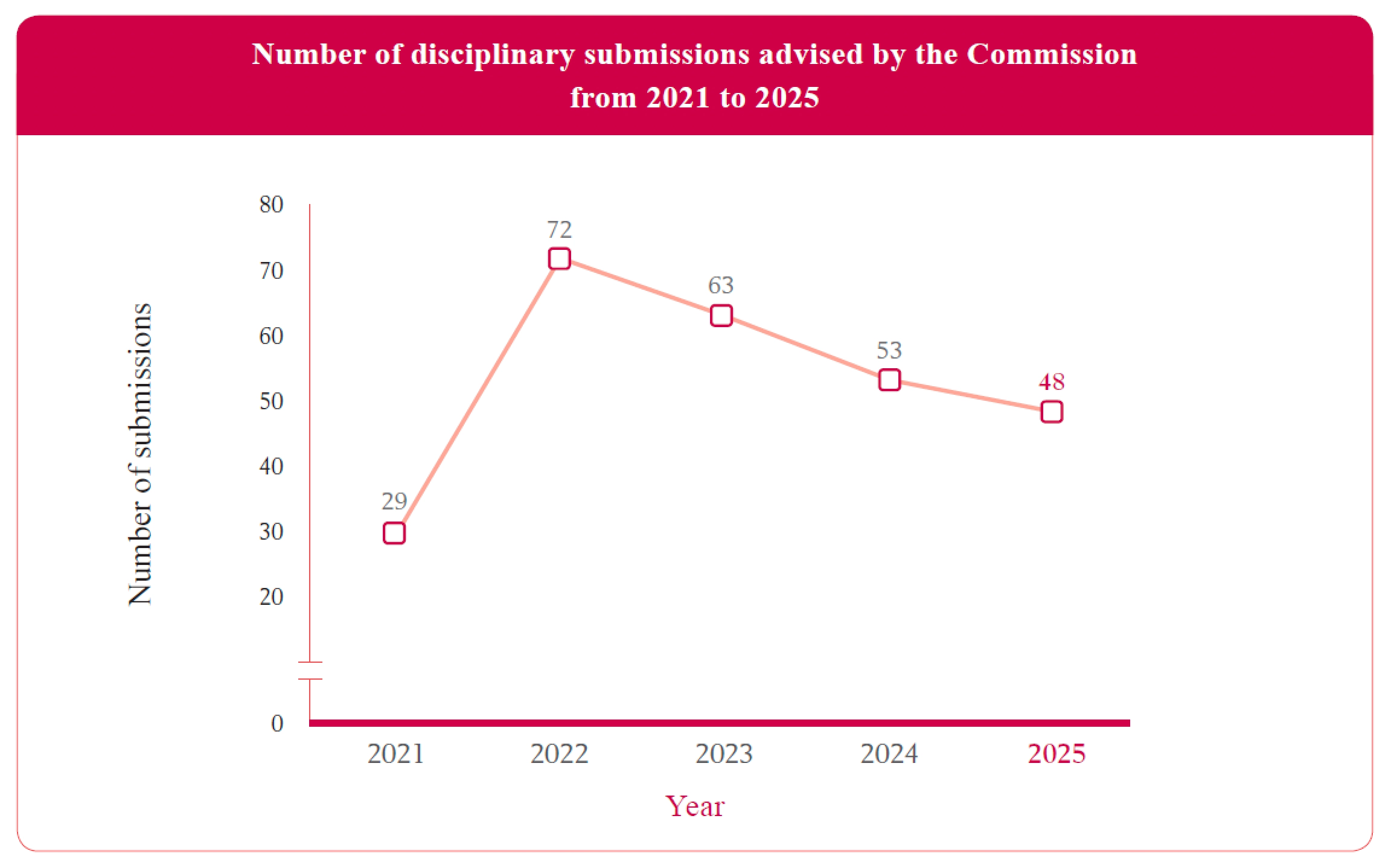
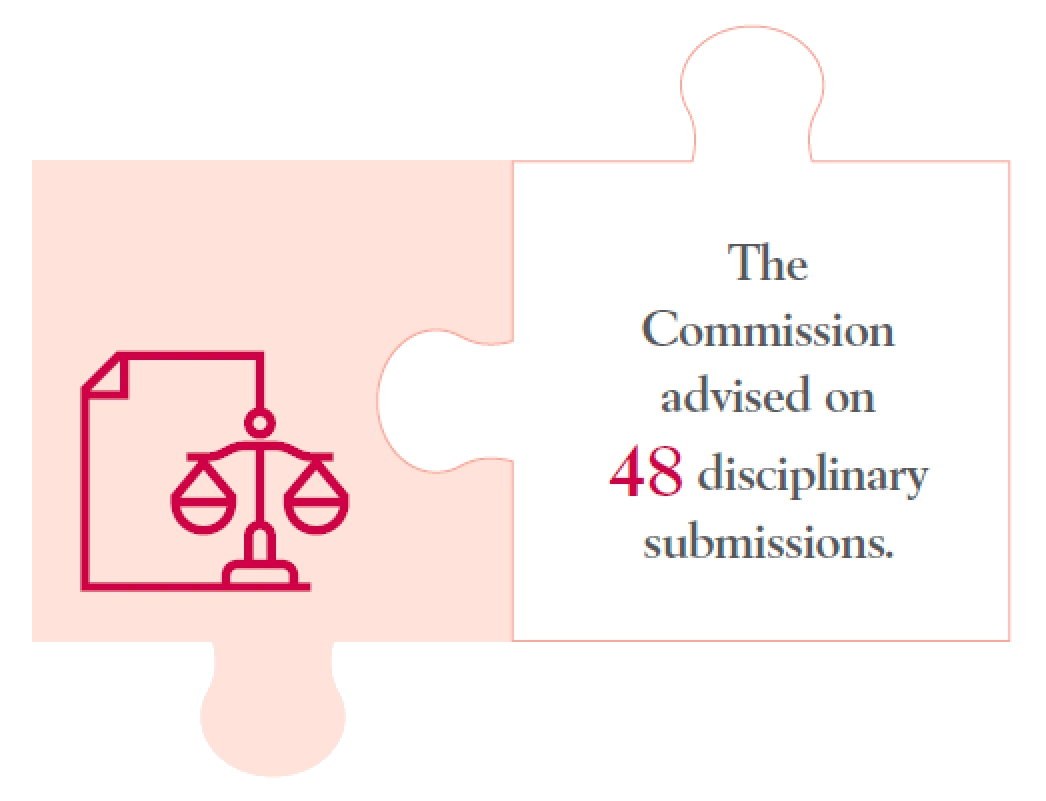
In 2025, the Commission advised on
48 disciplinary submissions which had
gone through the formal disciplinary
procedures prescribed under the
PS(A)O. It represents about 0.04% of
the 125 000 Category A officers within
the Commission’s purview. The number
of disciplinary submissions as advised by
the Commission in the past five years is
shown below –
5.5
As shown in the above chart, the number
of disciplinary submissions advised by the
Commission has remained consistently
low in the past five years. It indicates
that the great majority of our civil
servants have continued to measure up
to the very high standard of conduct and
discipline required of them. Nonetheless,
there is no room for complacency in
the concerted efforts to uphold a civil
service of high integrity and probity.
CSB has assured the Commission that
it will sustain its efforts in promoting
good standards of conduct and integrity
through training, seminars as well as
the promulgation and updating of rules
and guidelines. The Commission will, as
always, remain vigilant and collaborate
with the Government to ensure equity,
fairness and maintenance of broad
consistency in punishment throughout
the service.
5.6
To illustrate the nature of the 48
disciplinary submissions advised by the
Commission in 2025, a breakdown by
category of criminal offence/misconduct
and salary group is at Appendix IX.
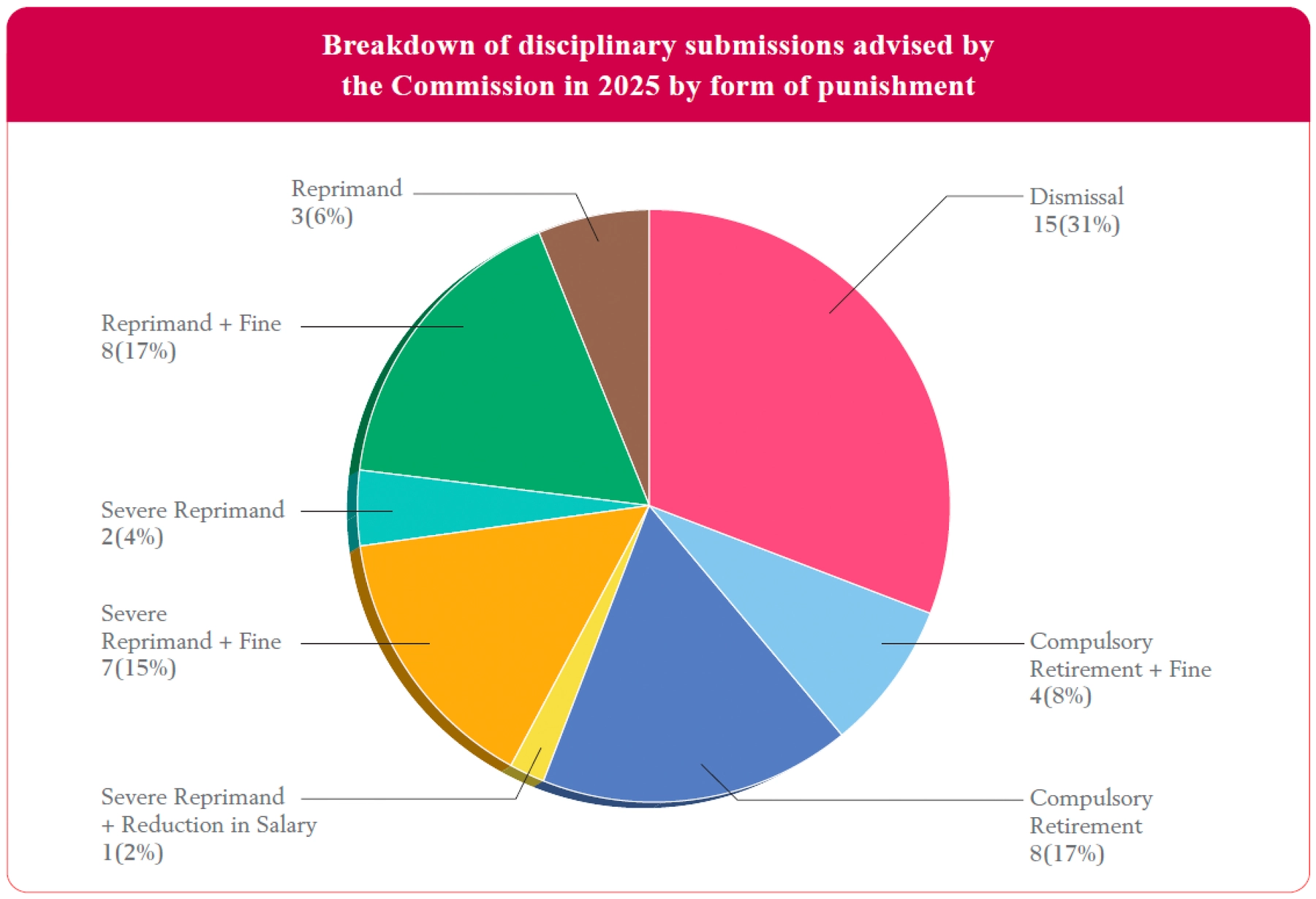
As depicted in the pie chart below,
more than half of the submissions had
resulted in the removal of the civil
servants concerned from the service
by “compulsory retirement”14 or
“dismissal”15, while 21% had resulted in
the officers receiving the punishment
of “severe reprimand”16. In about 42%
of the submissions, a financial penalty
was added in the form of a “fine”17 or a
“reduction in salary”18. These figures bear
testimony to the resolute stance that
the Government has taken against civil
servants who have committed acts of
misconduct or criminal offences.
14
An officer who is compulsorily retired may be granted retirement benefits in full or in part, and in the case of a pensionable
officer, a deferred pension when he reaches his statutory retirement age.
15
Dismissal is the most severe form of punishment as the officer forfeits his claims to retirement benefits (except the accrued
benefits attributed to the Government’s and the officer’s mandatory contribution under the Mandatory Provident Fund
Scheme or the Civil Service Provident Fund Scheme).
16
A severe reprimand will normally debar an officer from promotion or appointment for three to five years. This punishment
is usually recommended for more serious misconduct/criminal offence or for repeated minor misconduct/criminal offences.
17
A fine is the most common form of financial penalty in use. On the basis of the salary-based approach, which has become
operative since 1 September 2009, the level of fine is capped at an amount equivalent to one month’s substantive salary of
the defaulting officer.
18
Reduction in salary is a form of financial penalty by reducing an officer’s salary by one or two pay point(s). When an officer
is punished by reduction in salary, salary-linked allowance or benefits originally enjoyed by the officer would be adjusted or
suspended in the case where after the reduction in salary the officer is no longer on the required pay point for entitlement
to such allowance or benefits. The defaulting officer can “earn back” the lost pay point(s) through satisfactory performance
and conduct, which is to be assessed through the usual performance appraisal mechanism. In comparison with a “fine”,
reduction in salary offers a more substantive and punitive effect. It also contains a greater “corrective” capability in that it
puts pressure on the officer to consistently perform and conduct himself up to the standard required of him in order to “earn
back” his lost pay point(s).
Reviews and Observations on Disciplinary Issues
5.7
The Commission has been working in
close partnership with the Government
to identify, develop and promote good
practices in the management of the Civil
Service. We are pleased to note that
CSB has reviewed the PS(A)O and the
Public Service (Disciplinary) Regulation
with a view to enhancing the civil
service disciplinary mechanism. Having
sought the Commission’s views on the
proposals in 2025, CSB conducted staff
consultation and briefed the Legislative
Council Panel on Civil Service. We
look forward to the promulgation of the
enhanced measures in 2026.
5.8
Apart from deliberating and advising
on the appropriate level of punishment
for the cases it received for advice, the
Commission also makes observations
on them and initiates discussions with
CSB to explore scope for improvement
in handling disciplinary cases or
staff management. In the ensuing
paragraphs, we will highlight some of the
observations and recommendations we
have tendered in the year.
Staff management
5.9
It is beyond doubt that defaulting officers
are held directly accountable for their
misconduct acts. At the same time,
B/Ds should be on constant alert to
ensure the robustness of the control/monitoring mechanism of their
departmental operation. Effective
daily staff management is key to the
maintenance of a high standard of
staff conduct and discipline, and is
clearly more constructive than taking
punitive action after the occurrence of
misconduct. If misconduct happens,
supervising officers and the management
have the duty to identify any breeding
grounds for or circumstantial factors
leading to the cases so as to take remedial
actions decisively to avoid recurrence of
similar misconduct, as illustrated in Cases
5A to 5D below.
Case 5A
This case concerns two public venues in which a number of officers were found
having failed to perform duties at their assigned duty posts at the same time without
permission, affecting adversely the operation of the venues concerned. After
investigation, the Department found that the supervisors had not given approval for the
officers concerned to change their duty posts. With the misconduct acts established,
the service of those officers on probationary terms was terminated, whereas the
remaining defaulting officers on permanent establishment were subject to disciplinary
punishment.
The Commission was disappointed to note the lax office discipline. The wilful disregard of office discipline reflected badly on the defaulters concerned as well as the capability of their supervisors in staff management.
The Commission has urged the Department to –
We look forward to the implementation of enhanced measures to be worked out by the Department to prevent recurrence of similar misconduct acts in its venues and ensure effective provision of public service. The Department should also review its measures regularly, and refine them as and when necessary to ensure their effectiveness.
The Commission was disappointed to note the lax office discipline. The wilful disregard of office discipline reflected badly on the defaulters concerned as well as the capability of their supervisors in staff management.
The Commission has urged the Department to –
(a)
review the existing staff monitoring mechanism and implement practical
measures to step up its effectiveness, with a view to upholding the standard of
staff discipline in all the venues concerned operating under the Department; and
(b)
remind all supervising officers that they would be held accountable in maintaining
proper staff discipline under their purview. They should take prompt and decisive
actions against any malpractices in order to deter misconduct acts of their
subordinates.
We look forward to the implementation of enhanced measures to be worked out by the Department to prevent recurrence of similar misconduct acts in its venues and ensure effective provision of public service. The Department should also review its measures regularly, and refine them as and when necessary to ensure their effectiveness.
Case 5B
An officer often slept in the store room of his office during duty hours. However, the
supervisor was not aware of his misconduct until the receipt of a complaint made
by a staff member working in the same office. The supervisor, having immediately
checked and found the officer sleeping on the spot, simply warned him not to do so
and directed him to go back to work. A week later, the officer was found sleeping
again in the store room during duty hours. With the support of the records of closed-circuit
television, it was found that he had misconducted himself repeatedly. As the
officer was on probationary terms, the case was submitted to the Commission with the
recommendation of terminating his probationary service.
The case again reflected the lax office discipline and deficiency in staff management in the office concerned. In addition, the lenient approach adopted by the supervisor in handling the case conveyed a misleading message to the officer as well as other staff that the misconduct acts were tolerated.
In supporting the termination of the officer’s probationary service, the Commission has impressed upon the Department the need for making improvement in staff management by –
The case again reflected the lax office discipline and deficiency in staff management in the office concerned. In addition, the lenient approach adopted by the supervisor in handling the case conveyed a misleading message to the officer as well as other staff that the misconduct acts were tolerated.
In supporting the termination of the officer’s probationary service, the Commission has impressed upon the Department the need for making improvement in staff management by –
(a)
exploring and implementing more effective monitoring measures to enhance staff
supervision with a view to upholding office discipline at all times and ensuring
effective office operation; and
(b)
reminding all supervising officers of the importance of taking a resolute approach
in handling misconduct cases so that defaulting officers could be punished in a
timely manner and clearly understand the consequence of their misconduct acts.
Case 5C
Another Department received a complaint alleging that an officer had been absent
from duty. The officer worked together with three other officers in a team responsible
for performing outdoor duties. After investigation, the Department discovered that
all the four officers, including the team head, had committed the misconduct acts of
unauthorised absence and falsification of entries in the attendance record books. As
one of the officers was on probation, his service was terminated without recourse to
disciplinary action whereas the remaining three officers on permanent establishment
were subject to disciplinary punishment.
The involvement of the whole team in the misconduct case has revealed the Department’s slackness in office discipline and staff supervision, particularly among those frontline staff conducting outdoor duties. The falsification of entries in the attendance books further begged the question over the officers’ integrity. Noting that the Department has implemented various measures to enhance the monitoring of staff punctuality and attendance, the Commission has urged the Department to follow through the improvement measures and review their effectiveness from time to time to ensure that office discipline is upheld at all times.
The involvement of the whole team in the misconduct case has revealed the Department’s slackness in office discipline and staff supervision, particularly among those frontline staff conducting outdoor duties. The falsification of entries in the attendance books further begged the question over the officers’ integrity. Noting that the Department has implemented various measures to enhance the monitoring of staff punctuality and attendance, the Commission has urged the Department to follow through the improvement measures and review their effectiveness from time to time to ensure that office discipline is upheld at all times.

Effective daily staff management is key to the maintenance of a high standard
of office discipline and staff conduct.
Case 5D
An officer was recommended to be punished by dismissal as he had been late for work
habitually despite repeated reminders and warnings from his supervisors, and also failed
repeatedly to follow his supervisor’s instructions.
On closer examination of the case, the Commission noted that, having detected the officer’s lateness problem, the supervisors initially requested the officer to submit daily work progress reports by a specified time every morning. Seeing no improvement in the officer’s punctuality in the following two months, coupled with his repeated failure to submit work progress reports as instructed, the supervisors asked the officer to sign on an attendance register upon arrival in the office every day. Despite being so requested, the officer continued to be late for work. The Department eventually decided to initiate formal disciplinary action against the officer, by then the lateness problem had persisted for nearly a year.
The officer’s failure to improve his punctuality, despite the administrative measures imposed, reflected his blatant disregard of office discipline and his supervisors’ instructions. The Department should have taken more robust management actions at a much earlier time, including but not limited to, issuing advisory letters and taking summary disciplinary actions19 against the officer, instead of resorting to merely administrative measures.
The Commission noted that the Department had taken follow-up actions to request its supervisors to closely monitor staff attendance and remind them of their supervisory accountability in doing so. The Commission has further requested the Department to remind all supervising officers of the importance of taking a resolute approach in handling misconduct cases so that timely sanctions could be meted out to achieve the punitive effect.
On closer examination of the case, the Commission noted that, having detected the officer’s lateness problem, the supervisors initially requested the officer to submit daily work progress reports by a specified time every morning. Seeing no improvement in the officer’s punctuality in the following two months, coupled with his repeated failure to submit work progress reports as instructed, the supervisors asked the officer to sign on an attendance register upon arrival in the office every day. Despite being so requested, the officer continued to be late for work. The Department eventually decided to initiate formal disciplinary action against the officer, by then the lateness problem had persisted for nearly a year.
The officer’s failure to improve his punctuality, despite the administrative measures imposed, reflected his blatant disregard of office discipline and his supervisors’ instructions. The Department should have taken more robust management actions at a much earlier time, including but not limited to, issuing advisory letters and taking summary disciplinary actions19 against the officer, instead of resorting to merely administrative measures.
The Commission noted that the Department had taken follow-up actions to request its supervisors to closely monitor staff attendance and remind them of their supervisory accountability in doing so. The Commission has further requested the Department to remind all supervising officers of the importance of taking a resolute approach in handling misconduct cases so that timely sanctions could be meted out to achieve the punitive effect.
19
Verbal warnings and written warnings are forms of summary disciplinary actions taken in less serious cases of misconduct/offence that do not warrant formal disciplinary proceedings. A verbal warning and a written warning would normally debar an
officer from promotion and appointment for six months and one year respectively from the date of the issue of the warning.
The Commission’s advice is not required in summary disciplinary cases.
A robust and decisive approach in handling disciplinary cases will send a
clear message that inappropriate behaviours are not tolerated.
Processing time of disciplinary cases
5.10
Taking prompt and timely action in
processing disciplinary cases with
appropriate punishment meted out
is essential to the fair and effective
administration of the disciplinary system.
Delay in action not only weakens the
credibility of the system and the punitive
deterrent effect of the punishment,
it is also unfair to the involved
parties concerned, and undermines
the Government’s credibility of not
tolerating acts of misconduct.
5.11
In the past two years, the Commission
observed that a number of departments
had taken a relatively long time to
conclude their disciplinary cases.
Apart from reminding them of the
importance of processing disciplinary
cases expeditiously, we requested
those departments with more serious
problems to submit review reports to
the Commission suggesting measures to
be adopted to solve the problem. The
departments concerned had undertaken
in their review reports to implement
various enhancement measures to ensure
the timely processing of disciplinary cases
in future.
5.12
However, we still noted that in 2025,
there was room for improvement in the
timeliness of processing disciplinary cases
in a few other departments. Case 5E
below illustrates the lesson learnt arising
from a Department taking exceedingly
long time to conclude a disciplinary case.
Case 5E
A team of five officers, two being the team heads, was assigned to perform raiding duties
in designated districts at scheduled times during their duty shift. The officers recorded
in their attendance books that the duties had been completed as assigned. However,
subsequent departmental checks on the transportation records of the team revealed
that the team had returned to the office at a time much earlier than scheduled. The
officers were suspected to have failed to perform their assigned duties seriously and
made false attendance records.
The Department took nearly two years to conduct the departmental investigation. The Secretariat on Civil Service Discipline (SCSD) took another two years to process the case, including seeking supplementary information from the Department to substantiate the alleged misconduct acts, devising a new set of procedural guidelines for conducting a joint inquiry hearing for the case, conducting the joint inquiry hearing for the defaulting officers with common case background in one-go and allowing time for them to submit representations, among others. By the time the case was submitted to the Commission for advice on imposing disciplinary punishment against the defaulting officers concerned, some four years had lapsed since the discovery of the misconduct acts.
Whilst appreciating the need to observe the due process which would take time, the processing time of the case was still considered too long. The Department should have taken decisive and prompt action to process the case with a view to imposing the disciplinary punishment timely to achieve the maximum deterrent effect. The Commission has strongly urged SCSD and the Department to take reference of this case and to expedite the processing of similar disciplinary cases in future by –
Besides, the Commission noted that the Department had taken the initiative to implement various measures to strengthen its monitoring of staff attendance in the offices concerned, including the adoption of a system to record staff attendance electronically. We have further requested the Department to follow through the relevant measures and review their effectiveness regularly with a view to upholding staff discipline in future.
The Department took nearly two years to conduct the departmental investigation. The Secretariat on Civil Service Discipline (SCSD) took another two years to process the case, including seeking supplementary information from the Department to substantiate the alleged misconduct acts, devising a new set of procedural guidelines for conducting a joint inquiry hearing for the case, conducting the joint inquiry hearing for the defaulting officers with common case background in one-go and allowing time for them to submit representations, among others. By the time the case was submitted to the Commission for advice on imposing disciplinary punishment against the defaulting officers concerned, some four years had lapsed since the discovery of the misconduct acts.
Whilst appreciating the need to observe the due process which would take time, the processing time of the case was still considered too long. The Department should have taken decisive and prompt action to process the case with a view to imposing the disciplinary punishment timely to achieve the maximum deterrent effect. The Commission has strongly urged SCSD and the Department to take reference of this case and to expedite the processing of similar disciplinary cases in future by –
(a)
closely monitoring the processing of disciplinary cases at different stages to ensure
timely processing; and
(b)
arranging briefings and training to equip the Department’s staff with the
necessary skills in handling disciplinary investigations with a view to ensuring that
investigations would be conducted thoroughly and promptly.
Besides, the Commission noted that the Department had taken the initiative to implement various measures to strengthen its monitoring of staff attendance in the offices concerned, including the adoption of a system to record staff attendance electronically. We have further requested the Department to follow through the relevant measures and review their effectiveness regularly with a view to upholding staff discipline in future.
Early and swift disciplinary action is important to achieve the desired punitive
and deterrent effects.
Measures to help improve the processing of disciplinary cases
5.13
To step up the monitoring of the
processing of disciplinary cases and
to ensure the consistency in the level
of punishment meted out by B/Ds,
the Commission is pleased that CSB
has rolled out since 2023 various
measures for enhancing the civil service
disciplinary mechanism. These include
requiring B/Ds to report on a half-yearly
basis to their senior management and
CSB on the progress of their handling
of disciplinary cases and to strengthen
the monitoring of summary disciplinary
actions imposed against officers on
probationary or trial terms. Where cases
not handled in a proper and timely
manner were detected by CSB, it would
step in to understand the situations and
offer the necessary advice and assistance
to B/Ds.
5.14
As mentioned in paragraph 5.11 above,
the Commission would request B/Ds to
submit review reports for problematic
cases so that the B/Ds concerned could
identify causes for the problems and map
out improvement measures to tackle
them. In such review reports, we noted
that B/Ds had incorporated the advice
given by both the Commission and CSB
on the ways to strengthen their handling
and monitoring of disciplinary cases.
The Commission looks forward to seeing
actual improvements being made with
the implementation of such measures by
the B/Ds concerned.
5.15
In addition, SCSD has maintained its
out-reach visits to B/Ds to explore
scope to enhance mutual efficiency
in processing disciplinary cases. For
example, arising from the long processing
time of a disciplinary case in the year,
SCSD took the initiative to arrange an
out-reach visit and dedicated training
to the concerned Department to
improve the management capability
of its responsible officers in handling
disciplinary cases.
Staff training
5.16
The Commission noted that one of the
main reasons for the long processing time
of disciplinary cases was that supervisors
at the middle level were not adequately
equipped with staff management
skills, as well as the knowledge about
the handling procedures and the
appropriate level of punishment to
be meted out in disciplinary cases. As
mentioned in Chapter 1 of this Annual
Report (please see paragraph 1.14),
CSB, taking heed of the Commission’s
advice, developed an online training
programme for supervisors at the
middle level to strengthen their
skills in managing subordinates with
performance and/or conduct issues. To
facilitate the implementation of the
training programme, the Commission
had provided CSB with some case study
materials to illustrate to participants
the need and the ways for supervisors
to discharge their supervisory
responsibilities properly and diligently
so that some acts of misconduct by
their subordinates could be detected at
an early stage or even totally avoided.
We note that CSB had launched the
training programme in December 2025.
In addition to case studies, simple
quizzes are included to help strengthen
participants’ supervisory skills as well as
their understanding of their role in staff
supervision. We are pleased to note that
CSB has undertaken to refine the training
programme as and when necessary to
ensure its effectiveness.

5.17
Recognising that personnel assigned and
the investigation techniques they possess
are pivotal to the successful conclusion
of disciplinary cases, SCSD has acted on
the Commission’s advice and continued
to arrange capacity building workshops
for investigation work on disciplinary
cases. Such workshops are open to HRM
practitioners as well as departmental
managers who are responsible for
day-to-day staff management.
5.18
The Commission will continue to
collaborate with CSB, and provide
feedback and suggestions to facilitate its
pursuit of the training initiatives.